
Islamic Quotes About Mosques: A mosque or house of prayer is the first place we learn about as a Muslim. It is derived from the Arabic word masjid which means “place of prostration”. Mosques are symbolic of purity and resonate with the message of peace and tranquility. Like other sacred places, the followers of Islamic monotheism gather in the mosque for congregational prayers.
However, its purpose is not only limited to worship. Some mosques serve as institutes for managing activities like imparting teachings of the Holy Quran and Sunnah, conducting Nikkah (wedding) ceremonies, and collecting and disbursing of Zakat.
The Holy Quran and books of Hadith are filled with inspiring quotes about mosques and those Muslims who love to visit them. But before going into the details, here are some interesting facts about the history, architecture, and status of a mosque in Islam.
Historical Background of Mosques
It is a mistaken idea that Masjid- al-Haram holds the title of being the first mosque in Islam. Truthfully, the Holy Kaaba (Bait ul-Allah) itself was the first holy site constructed on earth. Before Islam, it was under the control of Pagan Arabs and was placed with idols and statues. Thus, after many years Mecca was cleansed with paganism, and Masjid- al-Haram was built around the Holy Kaaba. Here is an informative video explaining the history of the Holy Kaaba. You should also go through this list of the 8 Most Important Mosques & Their Significance for Muslims.
Similarly, Masjid al-Aqsa was constructed forty years after the Holy Kaaba. It was also considered an honorable site for generations by the People of the Book. Nevertheless, it attained the status of the mosque during Prophet Muhammad’s (PBUH) era.
So which is the first mosque in Islam? The answer is Masjid Quba (Quba Mosque) which is about 7km away from the grand Al-Masjid-an-Nabawi. The story goes that when Prophet Muhammad (PBUH) was forced to migrate from Mecca to Medina, he (PBUH) stopped at the village of Quba for several days. It was then when he (PBUH) laid the foundation of Masjid Quba and helped his companions in its manufacturing.
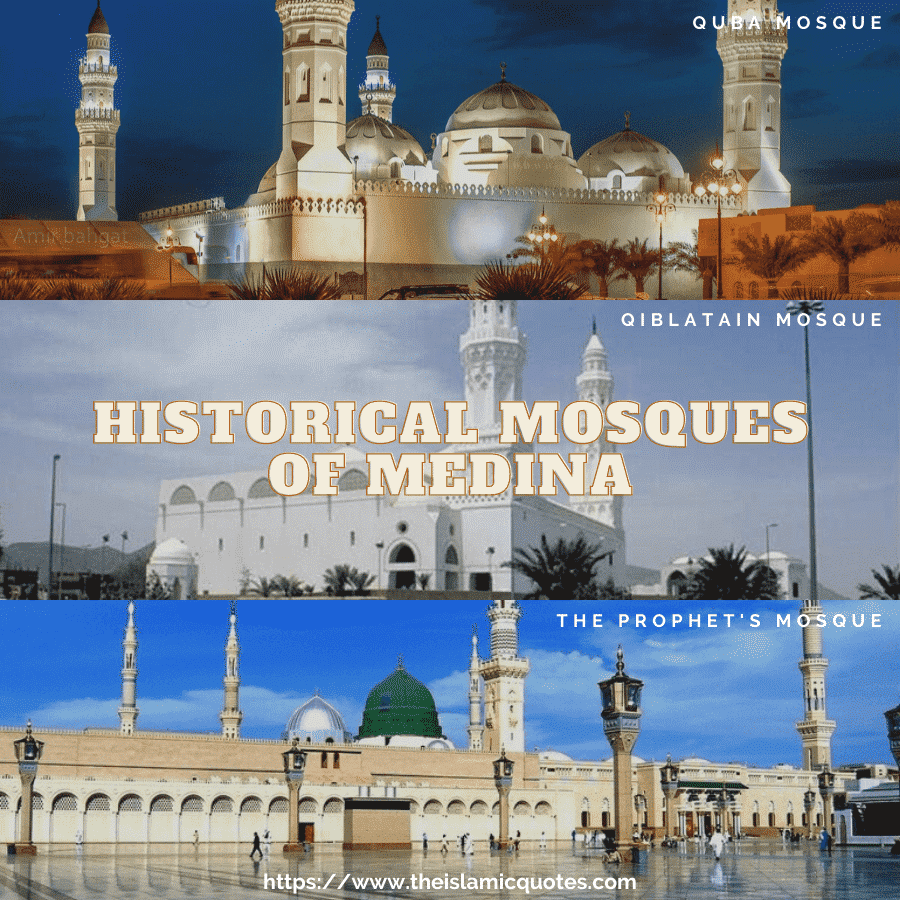
After Masjid Quba, came the turn of the building of Al-Masjid-an-Nabawi and Masjid al-Qiblatayn in Medina. Thus mosques begin to establish one after the other and gradually spread worldwide. Some of the renowned mosques of the world include Masjid Al-Kufa in Iraq, Mosque of Amr Ibn Al-As in Egypt, Huaisheng Masjid in Guangzhou China, Umayyad Mosque or the Great Mosque of Damascus in Syria, and Uqba Masjid or Al-Qayrawan Mosque in Tunisia.
Mosque Architecture
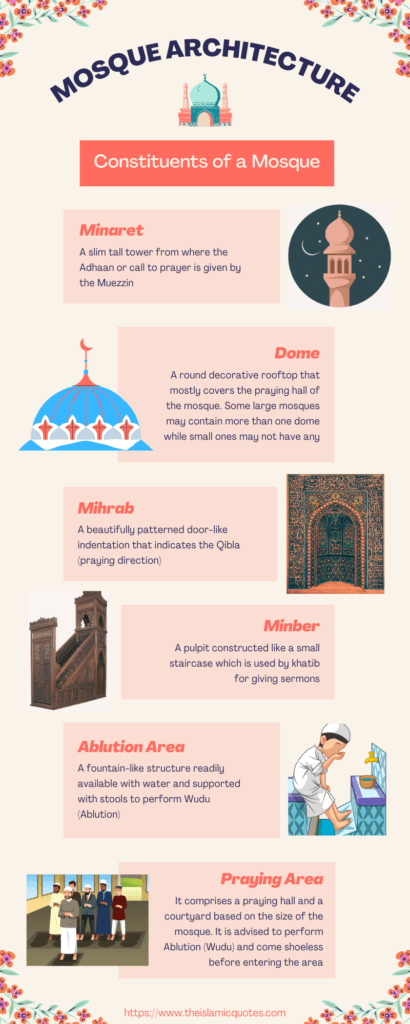
The physical beauty of mosques lies in their traditional designs which differentiates them from other religious constructs like churches, temples, and synagogues. They are the epitome of simplicity and elegance which is depicted from their special constituents. These constituents are better explained in the infographic below
Significance of Mosques in Islam
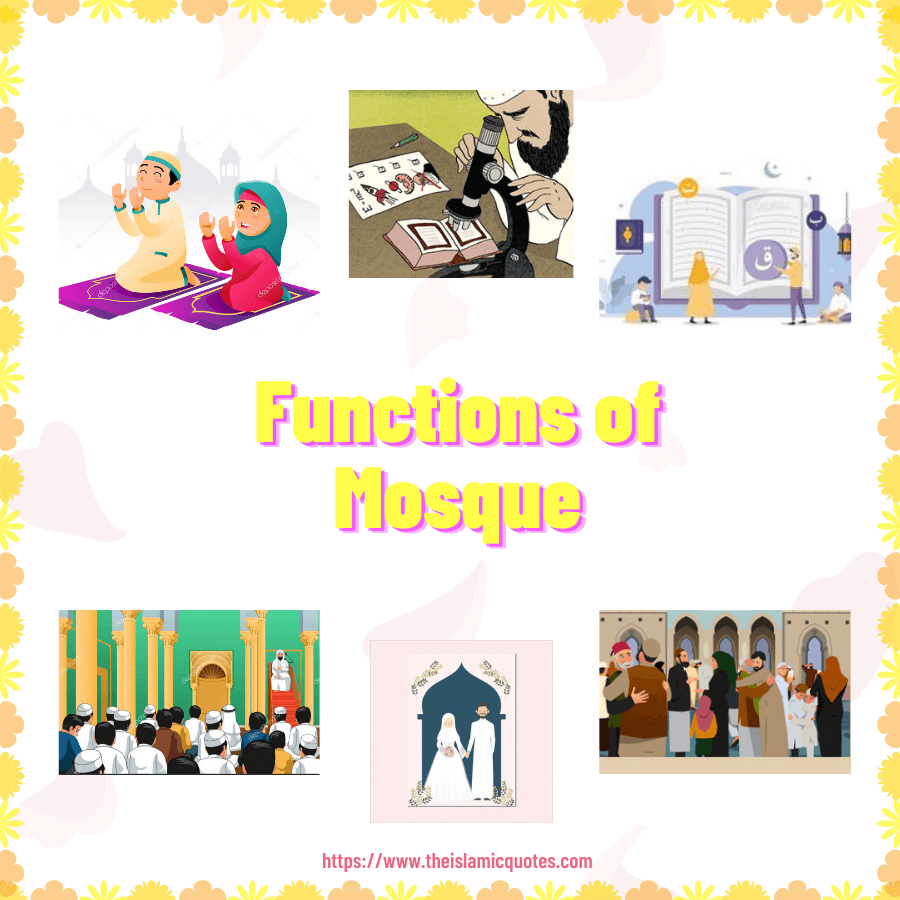
In the early days of Islam, mosques were the epicenter of religious education, social welfare, community gatherings, administrative work, and political affairs. Al-Masjid-an-Nabawi was the first mosque to attain this honor. Here knowledge seekers from Arab and abroad used to come to the Prophet Muhammad (PBUH) for guidance and learning. Let’s go through some functions of mosques that have been played a prominent role in their evolution. I would also recommend that you read our earlier post about Women Only Mosques.
Performing prayers
Probably the first and foremost function of a mosque is establishing a praying setup. Whether there are the obligatory five prayers, voluntary prayers, Jumu’ah (Friday) prayer, or the Eid prayer for festivals, mosques continue to remain a place for earning Allah Almighty’s blessings and rewards.
Imparting education
A role that was once the fundamental component of a mosque but now lost to modern ways are mosques as education facilities or madrasas. In the past, mosques used to be the first place of learning for men, women, and children. Subjects like the Arabic language, Quranic studies, Hadith, Fiqh, and Sharia were taught. Besides religious curriculum, scientific subjects like mathematics, chemistry, astronomy, physics, and medicine were also part of learning. Some centuries-old mosques that have been a hub of knowledge for Muslims are Al-Qayrawan Mosque and Zaytuna Mosque in Tunisia, Al-Qarawiyyin mosque in Morocco, and Al-Azhar Mosque in Egypt.
Socio-political activity center
Initially, mosques used to play the same role as today’s presidential houses and parliaments. Meeting foreign delegates, appointing caliphs and governors, discussing jihad, signing agreements, or handling judicial matters used to be carried out in mosques. Likewise, they also provided the platform for Muslim families to socialize like celebrating festivals, conducting marriages, and organizing events. However present-day mosques have lost much of these roles except Nikkah ceremonies which are still arranged in them.
Dress code for Mosque
Modesty is the veil every Muslim man and woman must wear at all times. It should reflect both from their appearances and actions. That is why dress codes for going outside or performing Salah have been clearly defined in the Sunnah of the Prophet Muhammad (PBUH).
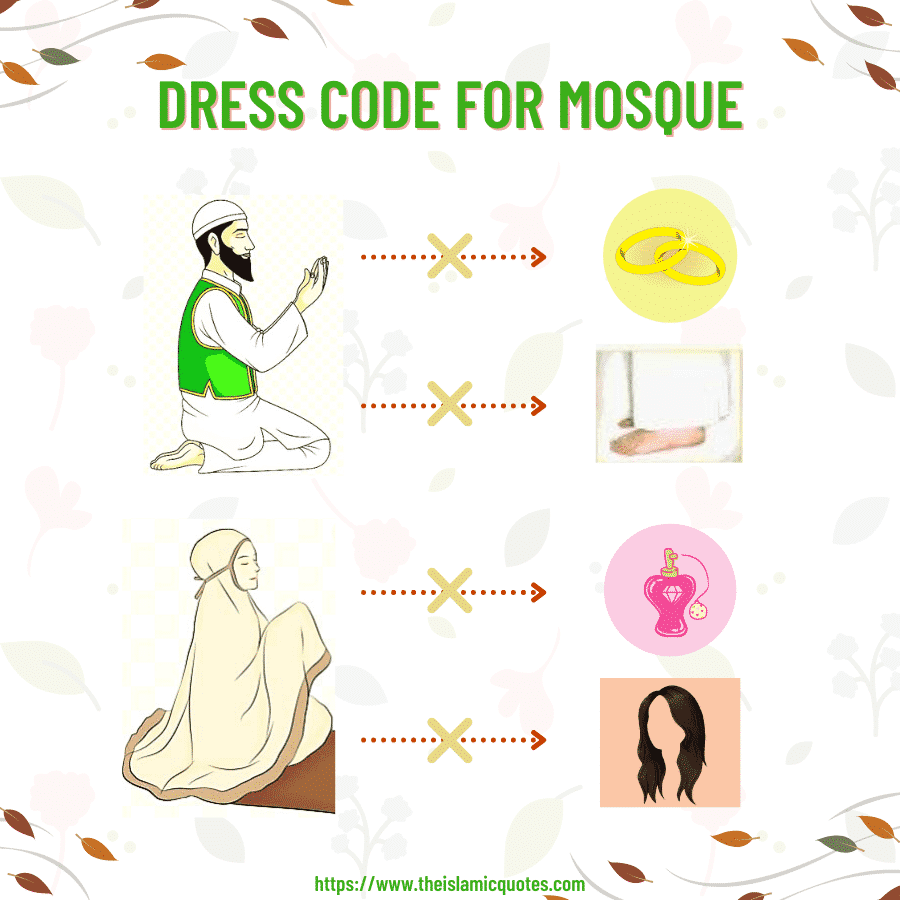
Dress code for men
Men are advised to wear clothes that are pure and permissible. They should be bought from halal income and not made from skins of animals that are considered haram. Their clothes should be loosely fitted, should cover the shoulders and the area between the navel and knees. A single garment is sufficient if it covers all the parts though care should be taken that it does not fall below ankles. Otherwise, men can wear scent in minimum amount but wearing gold and pure silk is not permissible in any situation.
Dress code for women
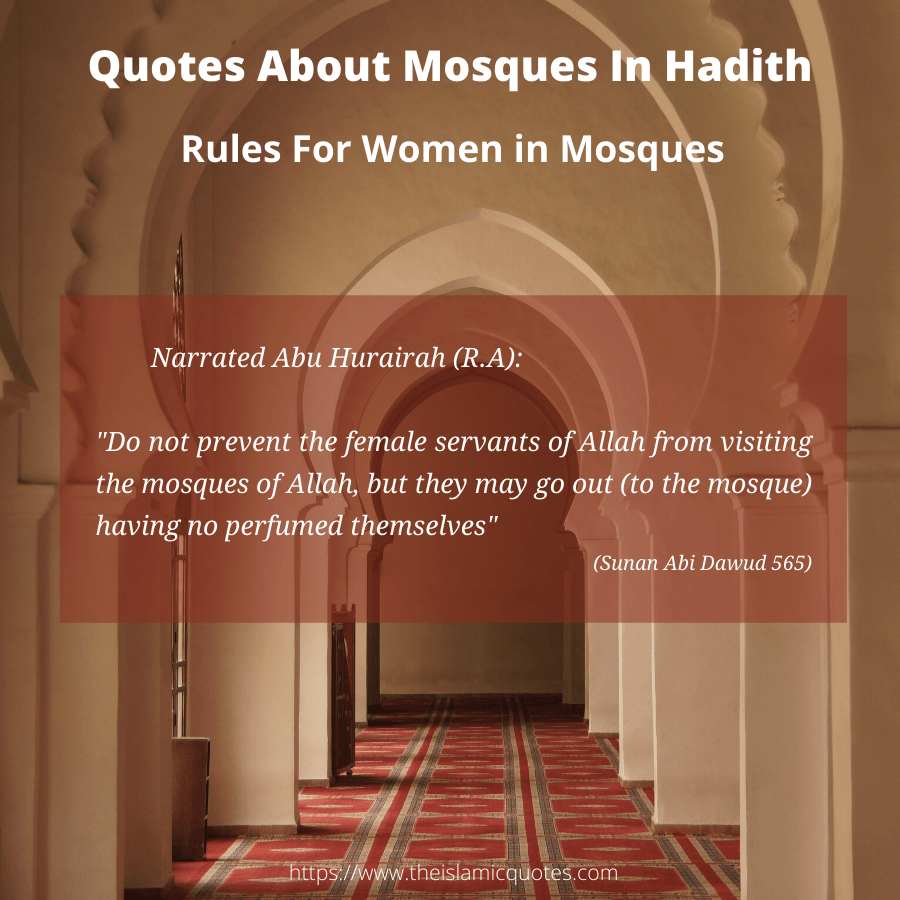
For women again the precondition for prayer and entering the mosque is cleanliness and permissible clothing. They should be completely covered in loose garments from head to foot. The face and hands may be uncovered in prayer according to the majority of scholars, while the feet are a point of difference: the Hanafi school allows them to be uncovered, whereas the Shafi’i, Maliki (preferably) and Hanbali schools require covering them in prayer. Though, it is strictly forbidden for Muslim women to wear strong perfumes in mosques or public spaces
Quotes About Mosques In The Holy Quran
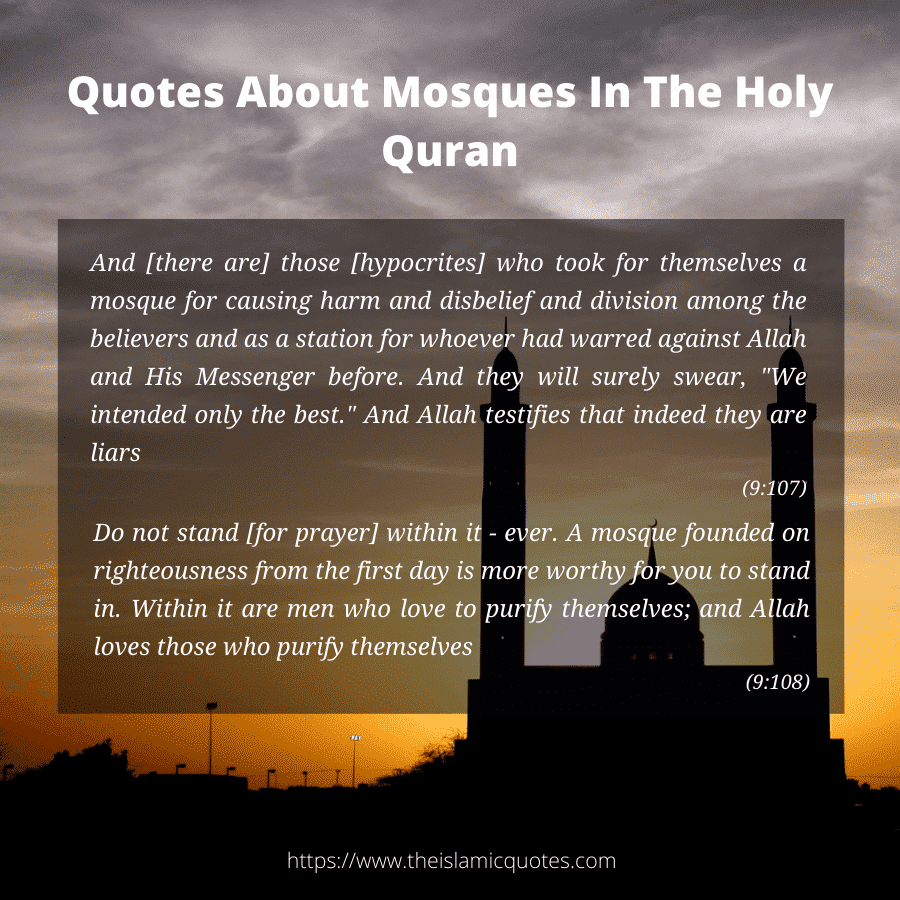
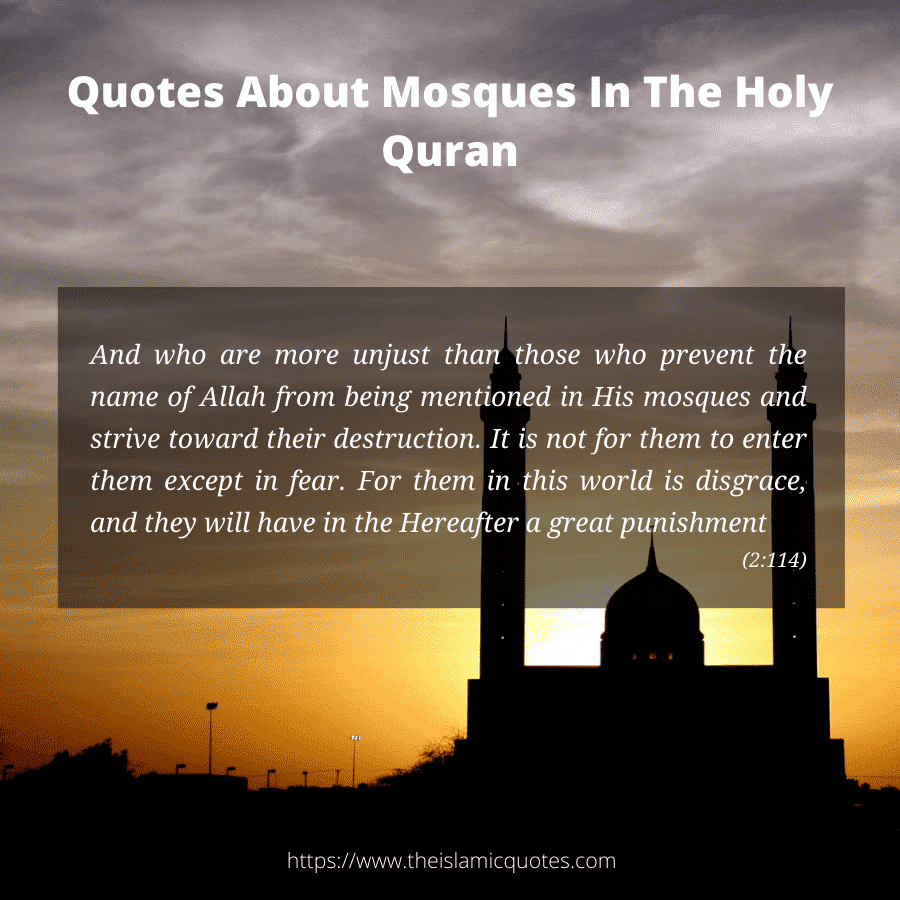
Mosques are prestigious in Islam. The word “masjid” appears around two dozen times in the Holy Quran in singular and plural forms (masajid). Their sole purpose is to polish the belief of a Muslim in the oneness of His creator as mentioned in the following verses:
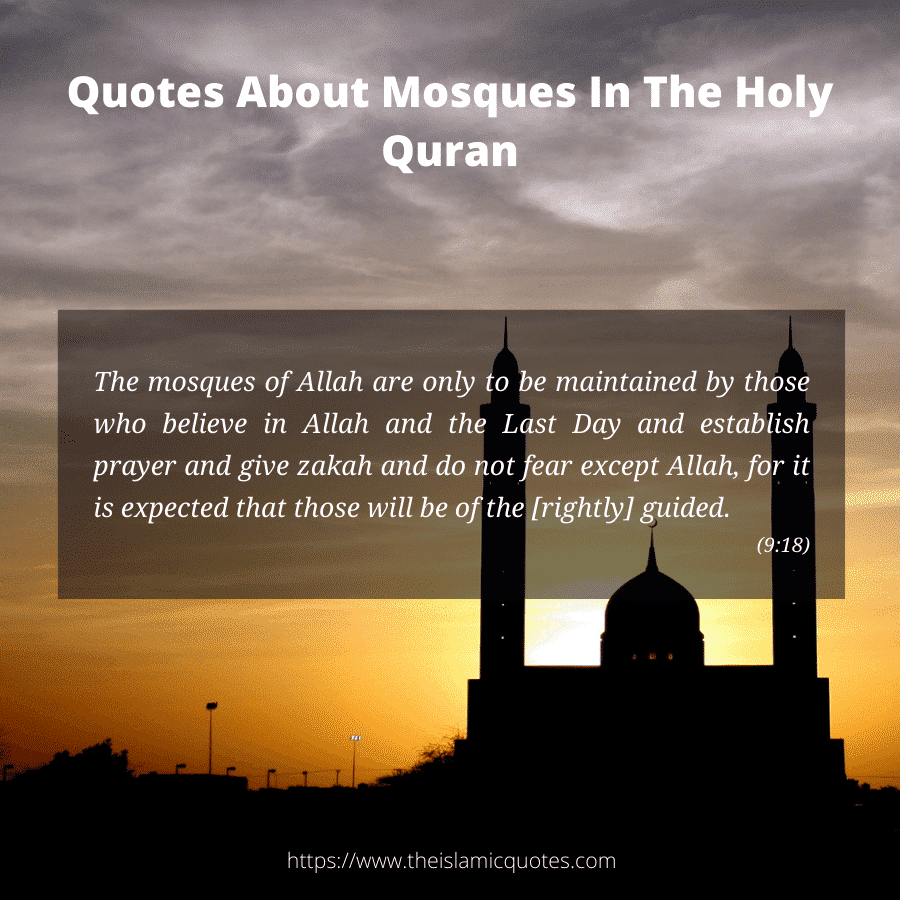
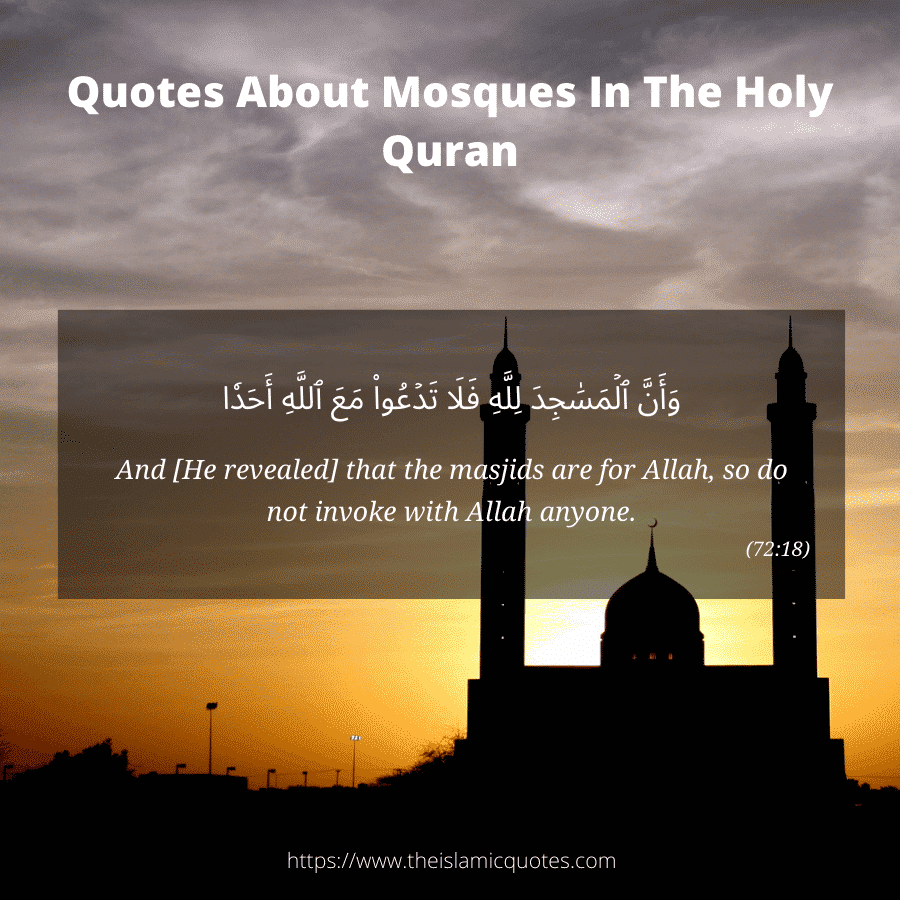
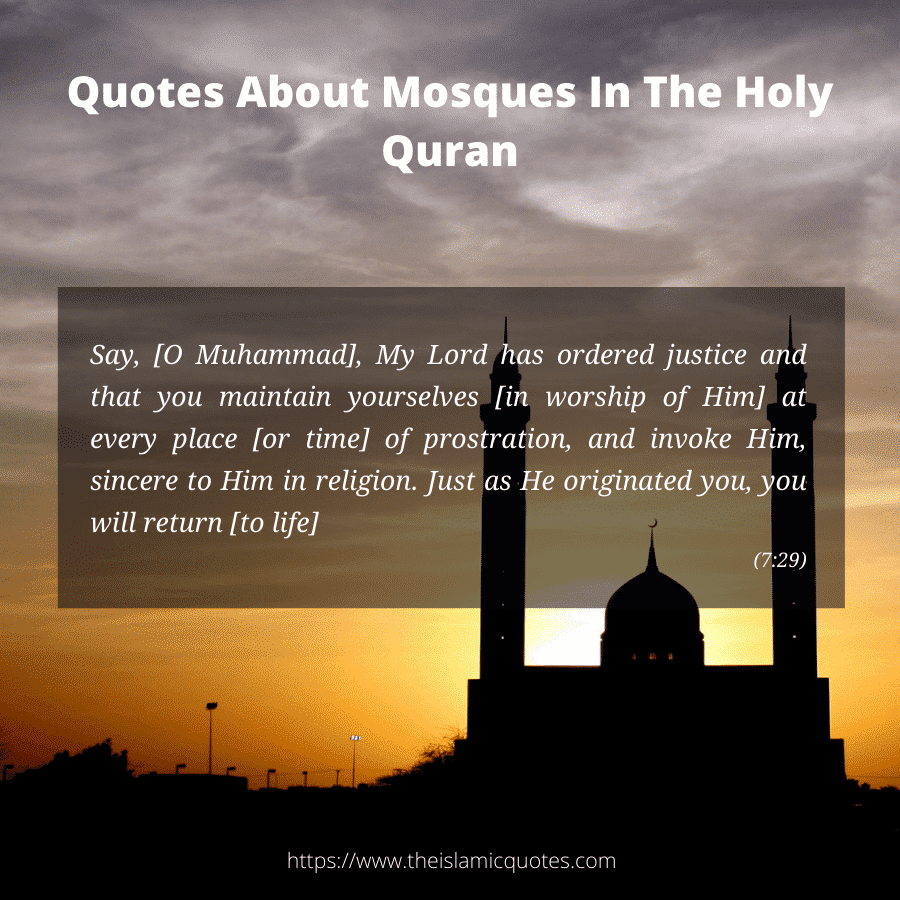
Mosques exuberate pureness and duty to God Almighty. Therefore any act of disbelief defying its sanctity is strictly forbidden and will be dealt with severity.
Quotes About Mosques In Hadith
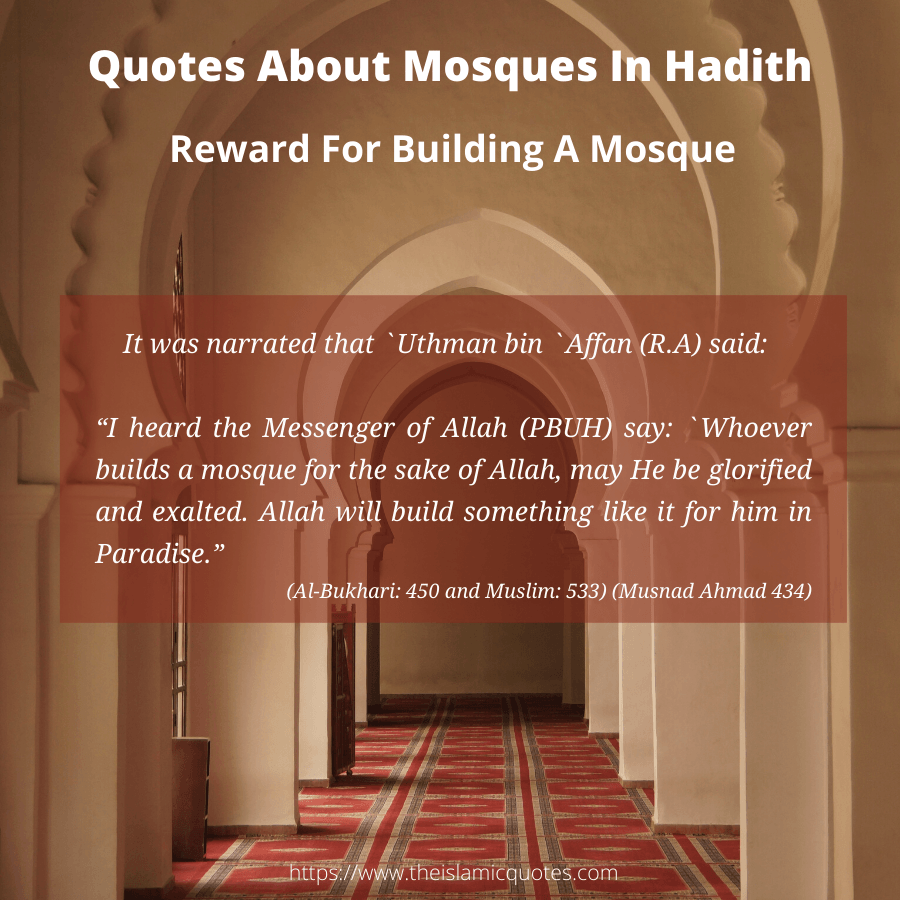
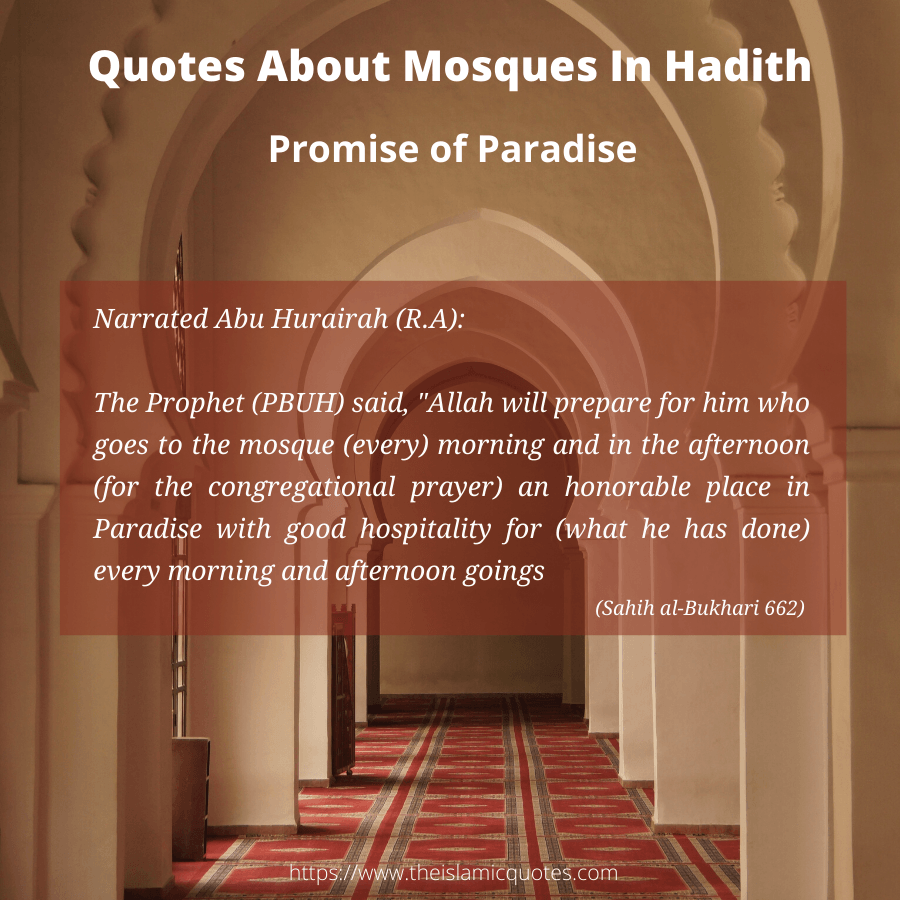
The teachings of the Prophet Muhammad (PBUH) are filled with instances where he guided Muslims about the true values of a Mosque. Furthermore, it has been reported in authentic books of Hadith that Allah Almighty has reserved great rewards for those who build mosques.
Additionally, the Prophet (ﷺ) said that a man’s prayer in congregation is twenty-five or twenty-seven times more rewarding than his prayer alone (Bukhari, Muslim). For women, praying at home is also rewarded, and they are not prevented from attending the mosque. Allah Almighty has even promised expiation of sins for those who visit the mosque regularly for mandatory prayers.
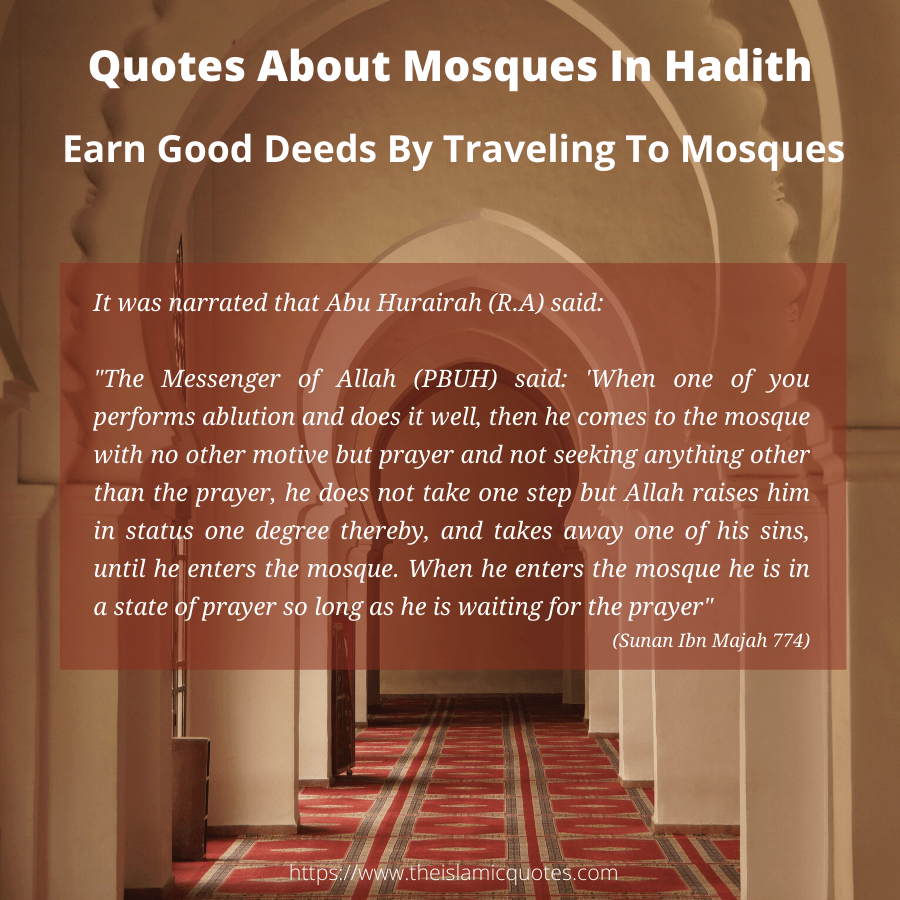
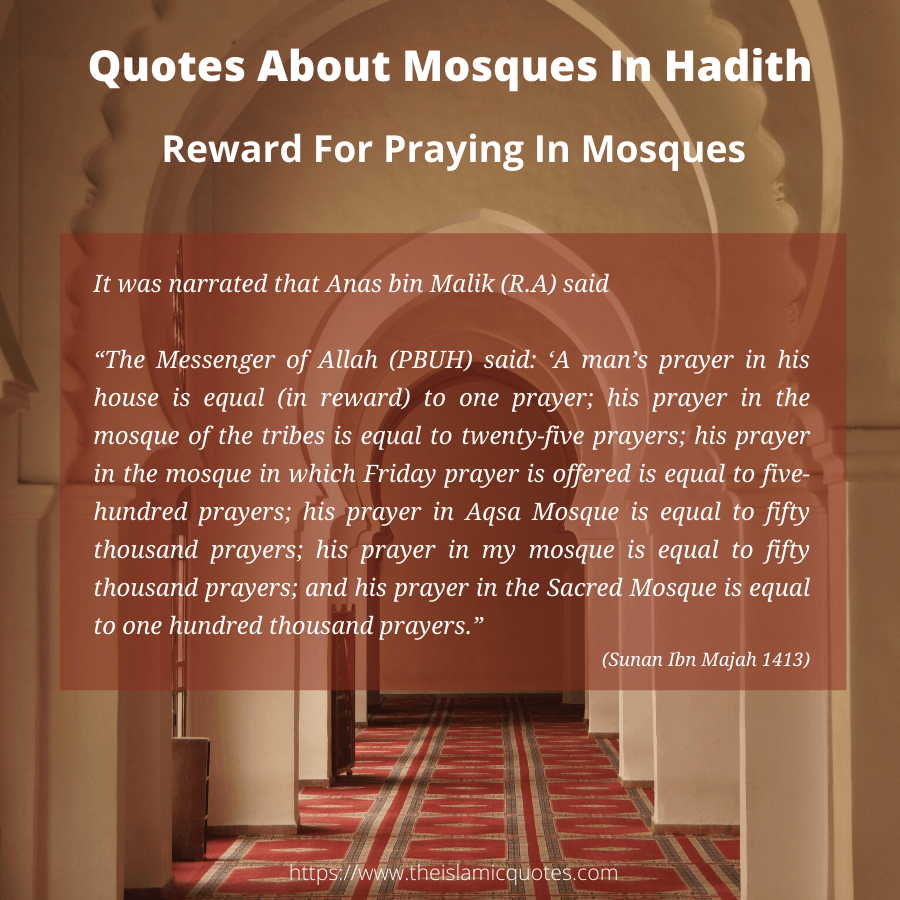
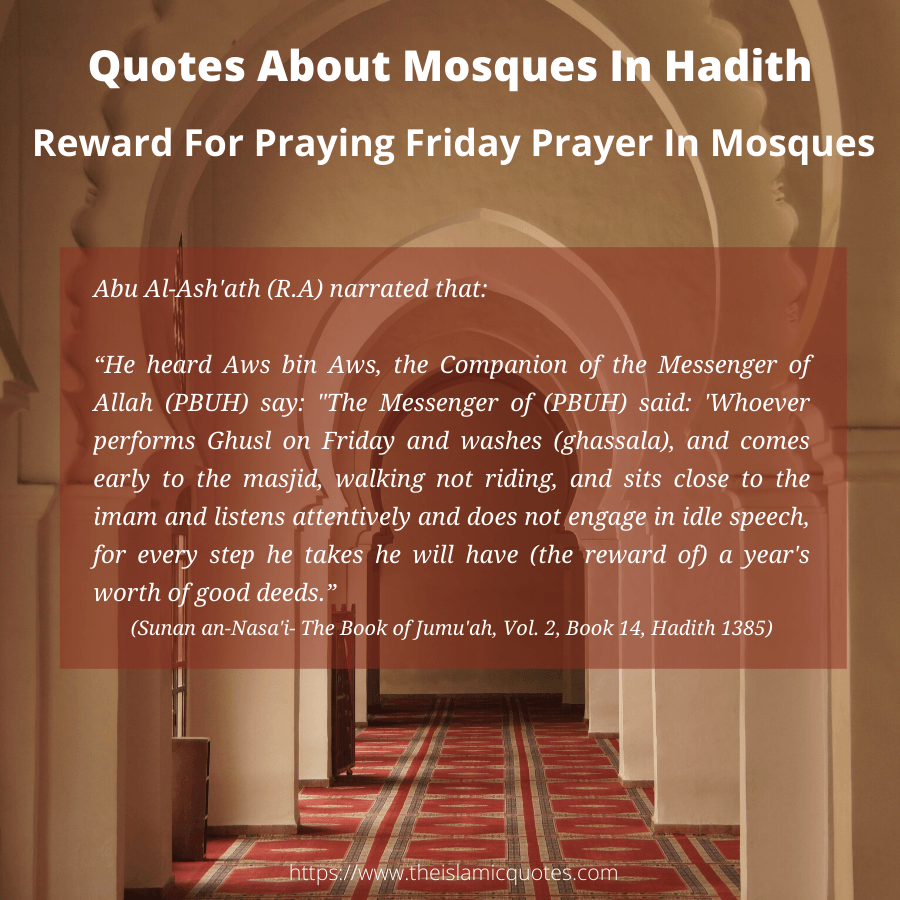
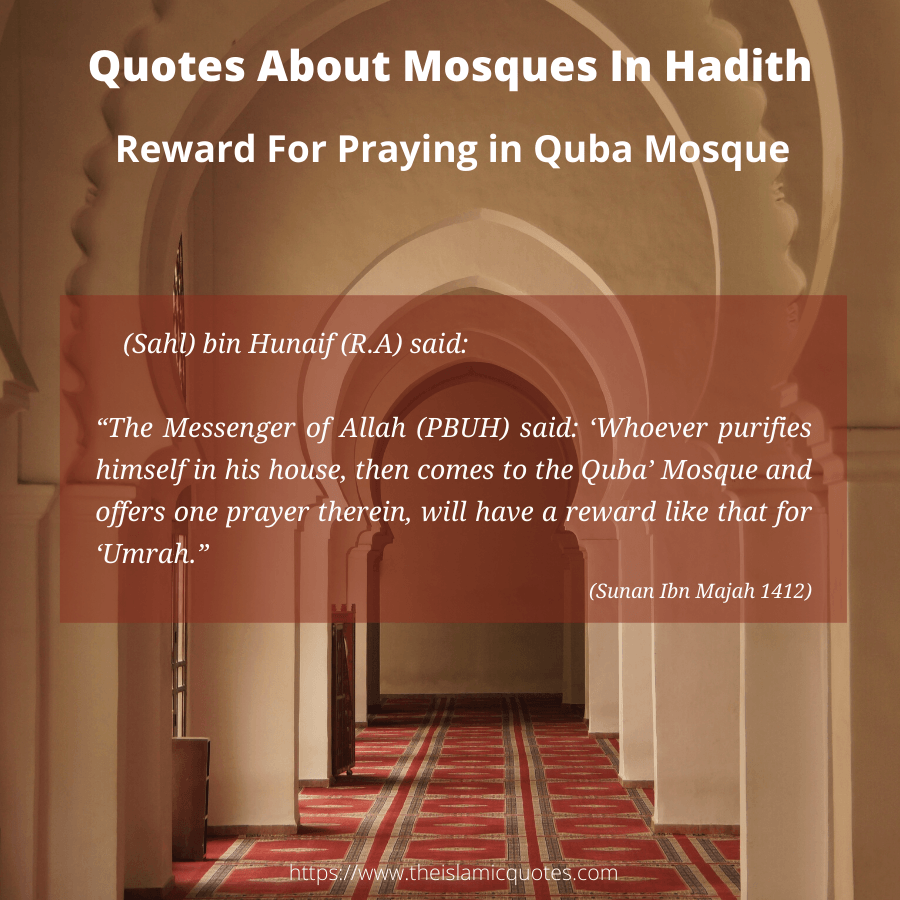
The Prophet (ﷺ) said that whoever purifies himself at home and then goes to Masjid Quba and prays there receives a reward like that of an Umrah (Tirmidhi, Ibn Majah). Prayer in the three sacred mosques (Masjid al-Haram, Masjid an-Nabawi and Masjid al-Aqsa) carries its own special, multiplied rewards.
The doors of a mosque are equally open for both men and women. Hence women should not be discouraged if they wish to pray in a congregation.
Conclusion
Going through all the details and quotes makes one realize how we are missing on developing a strong connecting with our Creator in mosques. The Supreme Lord who blesses us with good deeds even if we walk towards a mosque for prayer shows how much He cares for the believers of Islam. It is all up to us how we can prevent shaitan (devil) from corrupting our minds with laziness and procrastination. Consequently, it will strengthen our faith and keep us steadfast on the path of monotheism.
Frequently Asked Questions
Which was the first mosque in Islam?
The Kaaba was the first house of worship built for mankind (3:96), while Masjid Quba is generally regarded as the first mosque built by the Prophet (ﷺ) after the Hijrah. The Quran also mentions a mosque founded on piety from the first day (9:108), which many scholars identify with Quba, while others identify it with Masjid an-Nabawi.
Are women allowed to pray in the mosque?
Yes. The Prophet (ﷺ) said not to prevent the female servants of Allah from the mosques of Allah (Bukhari, Muslim). Congregational attendance is not obligatory for women, and praying at home is also rewarded.
Is congregational prayer in the mosque obligatory for men?
Scholars differ. Some hold it is an individual obligation, others a communal obligation (fard kifayah), and others a strongly emphasized Sunnah (Sunnah mu’akkadah). Ask a qualified scholar about your circumstances.
What should one wear and observe when going to the mosque?
Wear clean, modest clothing, avoid strong smells such as raw garlic or onion, and enter with the right foot while reciting the dua for entering. Etiquette is taught in the Sunnah; also see the role of the mosque in community welfare.
Can non-Muslims visit a mosque?
Scholars differ on entering Masjid al-Haram in Makkah, which is restricted. For other mosques, many scholars allow respectful visits with permission, while some require need or the mosque’s consent.