
Introduction of Surah Fatihah: Surah Al-Fatihah is the Makkan Surah. It comprises 7 verses out of which the first 3 verses elucidate that only Allah is worthy of all praise. Whenever a man is admiring the beauty of something or someone in this world, the person is indirectly praising Allah because Allah has created all worlds and whatever is in between, belongs to Allah SWT.
In the next two verses, Allah teaches His creation the way to supplicate to Allah. Surah al Fatihah is a very fascinating Surah because eradicated the concept of all types of Polytheism and brought people back towards monotheism even for their smallest desires.
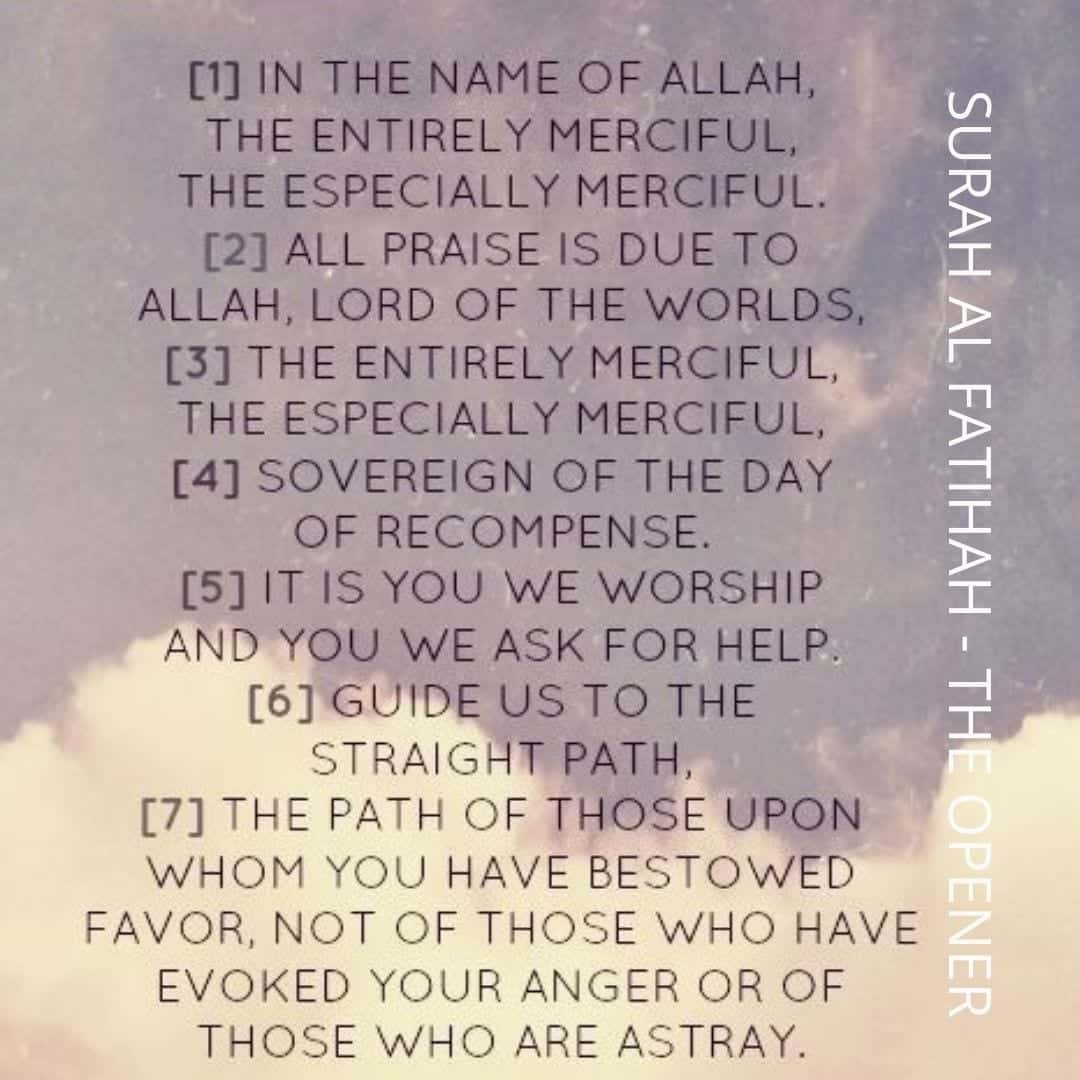
The words described in Surah Fatihah are as follows
- Al-Hamd: Praise to Allah
- Rabb: The one who nourishes
- Alameen: All the worlds
- Rahman: Compassionate
- Raheem: Merciful
- Malik: Master
- Yaum id deen: The Day of Judgement
- Iyyaka: we only seek from You(Allah)
- Naabudu: We worship
- Nastaeen: help us
- Ihdi: guide us
- Sirat: way
- Al Mustakeem: right
- Ghair: not
- Maghzoob: Those who earn Your anger
- Zaaleen: Those who go astray
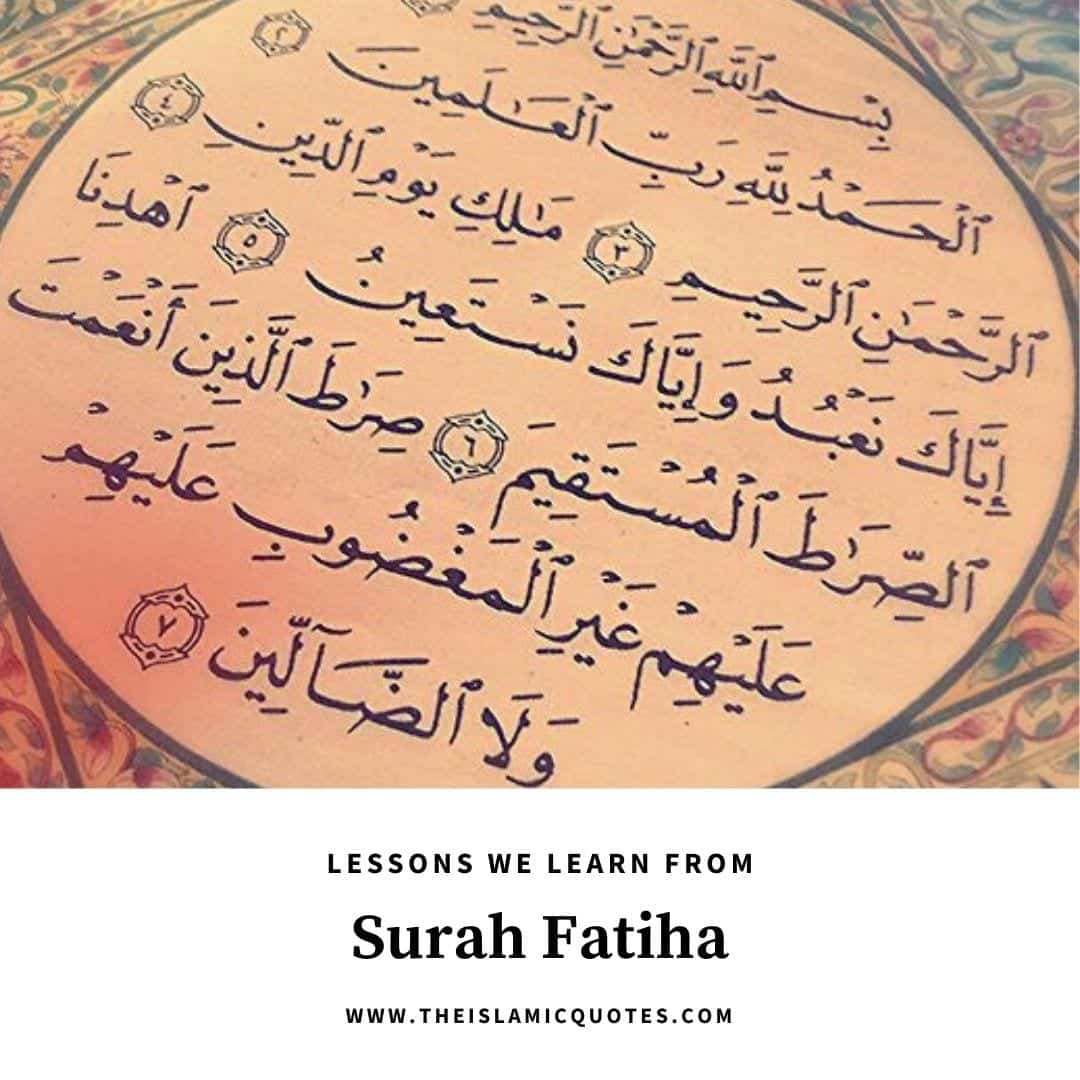
Significance of Surah Fatihah:
The importance of Surah Fatihah lies in the Hadith in which Prophet Muhammad (S A W) said,
لا صلاة لمن لم يَقْرَأْ بفاتحة الكتاب
There is no Salah (Prayer) without Surah Fatihah. Scholars agree on its great status in prayer; the Shafi’i, Maliki and Hanbali schools make it obligatory in every rak’ah, while the Hanafi school treats it as wajib (necessary) and holds that the prayer is still valid if it is missed, though it must be made up with sujud al-sahw. Bukhari:756
Different Names of Surah Fatihah:
Surah Fatihah has any names, some of them are listed below
- Bab ul Kitab(Door of the Holy Book)
- Fatihat ul Kitab(Opening of the Book)
- Surat ul Shifa(Treatment Surah)
There is consensus on the fact that the Quran is the quintessence of all the Holy books. It implies that Allah has collected briefly in “The Holy Quran” the wisdom and laws clarified in the entirety of the divine books already.
The knowledge, wisdom, and Islamic lifestyle demonstrated in Quran is fundamentally a preface of Surah Baqarah. Likewise, the Surah Al-Fatihah is additionally a summary of the whole Quran.
All of the basic principles which are elaborated in the whole Quran are the main topics of Surah Al-Fatihah. That is why Surah Al-Fatihah has been titled in authentic ahadith as “Umm al-Quran” which means “Essence of the Quran”.
The Surah begins with the Praise of Allah Almighty and ends with the request for guidance. The whole Quran is the answer to that request.
I also recommend that you go through these Lessons & Benefits of Surah Rehman.
Benefits of Reciting Surah Fatihah:
- A Companion recited Surah Fatihah as ruqyah over a man stung by a scorpion and he recovered by Allah’s will, and the Prophet approved of it (Sahih al-Bukhari 5736). Recitation is a form of dua and does not replace seeking proper medical treatment.
- When Imam says the last two verses of Surah Fatihah, say Ameen because if one’s utterance of this word synchronized with those of Angels, all of his previous sins will be forgiven. (Sahih al-Bukhari 780, Sahih Muslim 410)
- It is hoped that Allah SWT helps those who, in their difficult times (see also our duas for exams), recite اِهْدِنَا الصِّرَاطَ الْمُسْتَقِيْمَ e.g., during exams, or if we want anything from Allah.
- Reciting Surah Fatihah with sincerity and then asking Allah is a recommended way to make dua, and we hope for acceptance, though Allah answers in the way and time He knows is best.
- Some scholars recommend reciting Quran, including Surah Fatihah, near a dying person for comfort, but there is no authentic text that specifies this for Surah Fatihah. The well-established sunnah is to prompt the dying person with the shahadah (Sahih Muslim 916).
What Does Surah Al Fatihah Teach Us?
There are 7 reasons why Surah Fatihah is the essence of the Holy Quran (for another great surah, see the benefits of Surah Baqarah)
↓ 7 – Beauty of the Phrase ” Alhamdolillah”
This phrase in Surah al-Fatihah essentially encloses all of Allah’s praise. The various verses in the Quran are also describing the greatness of Allah.
There is a difference between praise and Hamd. Hamd is a noun but praise is a verb. Hamd is permanent but praising is temporary either for past, present, or future. It means Allah is eternal. Allah has chosen specifically for himself the word “Hamd” however we praise people too.
One of the verses is as follows
اللَّهُ لَا إِلَٰهَ إِلَّا هُوَ الْحَيُّ الْقَيُّومُ ۚ لَا تَأْخُذُهُ سِنَةٌ وَلَا نَوْمٌ
“Allah – there is no God except Him, the Ever-Living, the Sustained of [all] existence. Neither drowsiness overtakes Him nor sleep.
(Surah al-Baqarah:255)
Hamd is a unique word that is used to illustrate the characteristic qualities of only Allah. When Al comes before hamd (as in Surah Fatiha) it becomes more particular and specific that all of the praise of Allah come under al hamd.
When we recite the opening verse of Surah Fatihah, it should come from the heart, and Allah looks at our hearts and our sincerity.
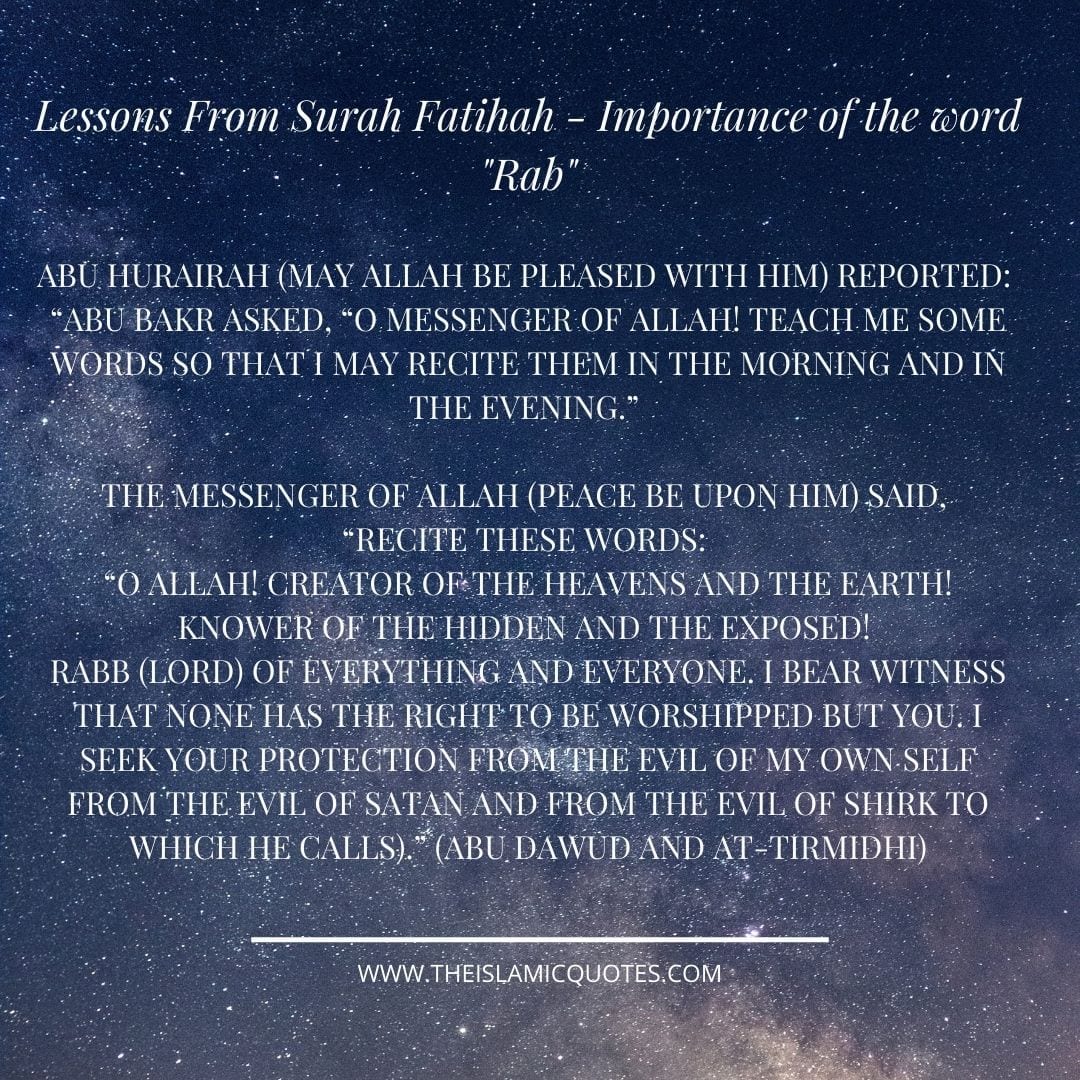
↓ 6 – Significance of the word “Rabb”
It covers the Lordship (Raboobiyyat) of Allah. The English word for Rabb is Lord which means “the one who nourishes”
The growth of all the creatures is indirectly related to the attribute Lordship of Allah. The love, kindness, and mercy embedded in a parent’s heart are showing Allah’s Rabobiyyat. The Prophet (peace be upon him) taught that Allah is more merciful to His servants than a mother is to her child (Sahih al-Bukhari and Sahih Muslim). A mother doesn’t want his child to burn in hellfire that is why Allah said in Quran about the parents.
وَاخْفِضْ لَهُمَا جَنَاحَ الذُّلِّ مِنَ الرَّحْمَةِ وَقُلْ رَبِّ ارْحَمْهُمَا كَمَا رَبَّيَانِي صَغِيرًا
And lower to them the wing of humility out of mercy and say, “My Lord, have mercy upon them as they brought me up [when I was] small. Surat al Isra:24
Allah has made this world for us and created us for His worship.
↓ 5 – Only Allah is Ar-Rahman and Ar-Raheem
These words in Surah Fatihah have mantled Allah’s attributes.
The attribute names Ar-Rahman and Ar-Raheem both mean merciful but there is a distinct difference in both of the names. It is only because of these two attributes of Allah that we are provided with everything
- Ar Rahman is the One who is merciful to everyone in this world however Ar-Raheem delineates the extra mercy of Allah for believers on the Day of Judgement.
- Ar-Rahman is that Lord who gives everything to its creation however by the grace of Raheem quality, we are given the best things upon request.
- Ar-Rahman quality is used only for Allah while Ar-Raheem can be used for both Allah and his creation.
↓ 4 – All of the events of the Day of Judgement are covered under the third verse of Surah Fatihah
مَالِكِ يَوْمِ الدِّيْن which means “Master of the Day of Judgement”
In Surah Fatihah, Allah has just named an event “the day of judgment”. The events which are going to happen on the day of Judgement are sequentially presented in other chapters of the Quran.
In Quran, Allah SWT called Mankind towards Him in different ways. Most of the chapters contain the discussion of blessings and Paradise, but there are some creations that go towards satan’s ways. So Allah SWT is just presenting a glimpse of His Jabbariyyat like in Surat Qariyah where Allah SWT establishes that He can also make you enter hellfire so that people come near to Allah SWT
القارعة مَا الْقَارِعَةُ وَمَا أَدْرَاكَ مَا الْقَارِعَةُ يَوْمَ يَكُونُ النَّاسُ كَالْفَرَاشِ الْمَبْثُوثِ وَتَكُونُ الْجِبَالُ كَالْعِهْنِ الْمَنْفُوشِ
The striking Calamity. What is the striking calamity? And what makes you know what is the striking calamity? The day when the people will be like dispersed moths and the mountains will be fluffed up wool. (Surat al-Qari’ah 101:1-5)
Learn more on this from our previous post on the Signs of Judgment Day.
↓ 3 – Allah is the Only One Worthy of Being Worshipped
اِيَّاكَ نَعْبُدُ “You alone we worship” is indicated in other wordings in many of the verses of the Quran. All of the signs on this earth are saying that Only Allah is worthy of being worship. For example, The Sun rising on its time every day is telling us that there is someone who has doctrine power. The moon, the stars revolving, the day and night all of them are giving us just one lesson that we can only worship Allah.
From all of the higher status like Wilayat(Authority), Nabuwwat(Prophethoodness), and Risalat(Apostleship), Abdiyyat is the most superior stage.
Allah said in the Quran,
سُبۡحٰنَ الَّذِیۡۤ اَسۡرٰی بِعَبۡدِہٖ لَیۡلًا مِّنَ الۡمَسۡجِدِ الۡحَرَامِ اِلَی الۡمَسۡجِدِ الۡاَقۡصَا الَّذِیۡ بٰرَکۡنَا حَوۡلَہٗ لِنُرِیَہٗ مِنۡ اٰیٰتِنَا ؕ اِنَّہٗ ہُوَ السَّمِیۡعُ الۡبَصِیۡرُ
Glory be to Allah who took his servant Prophet Muhammad by night from Sacred Mosque to the farthest Mosque Whose surroundings we have blessed so that We may show Him some of the signs. Surat al Isra 17:1
In another verse about Prophet Iesa, Allah has shown the greatness of the word Abdiyyat,
فَأَتَتْ بِهِ قَوْمَهَا تَحْمِلُهُ قَالُوا يَا مَرْيَمُ لَقَدْ جِئْتِ شَيْئًا فَرِيًّا يَا أُخْتَ هَارُونَ مَا كَانَ أَبُوكِ امْرَأَ سَوْءٍ وَمَا كَانَتْ أُمُّكِ بَغِيًّا فَأَشَارَتْ إِلَيْهِ قَالُوا كَيْفَ نُكَلِّمُ مَن كَانَ فِي الْمَهْدِ صَبِيًّا قَالَ إِنِّي عَبْدُ اللَّهِ آتَانِيَ الْكِتَابَ وَجَعَلَنِي نَبِيًّا
Then She(Maryam A.S) came to her people carrying a baby. They said, Oh Maryam, Indeed you have brought a terrible thing(27) Oh sister of Haroon (not a brother of Musa), Your Father was not a man who used to commit adultery nor your Mother was unchaste woman(28)Then she pointed to Him. They said How can we talk to a child who is in cradle(29)The child said, “I am a slave of Allah, Allah has given me the Holy book and made me Prophet. Surat Maryam 19:27-30
↓ 2 – Surah Fatiha Offers a Good News to the Believers
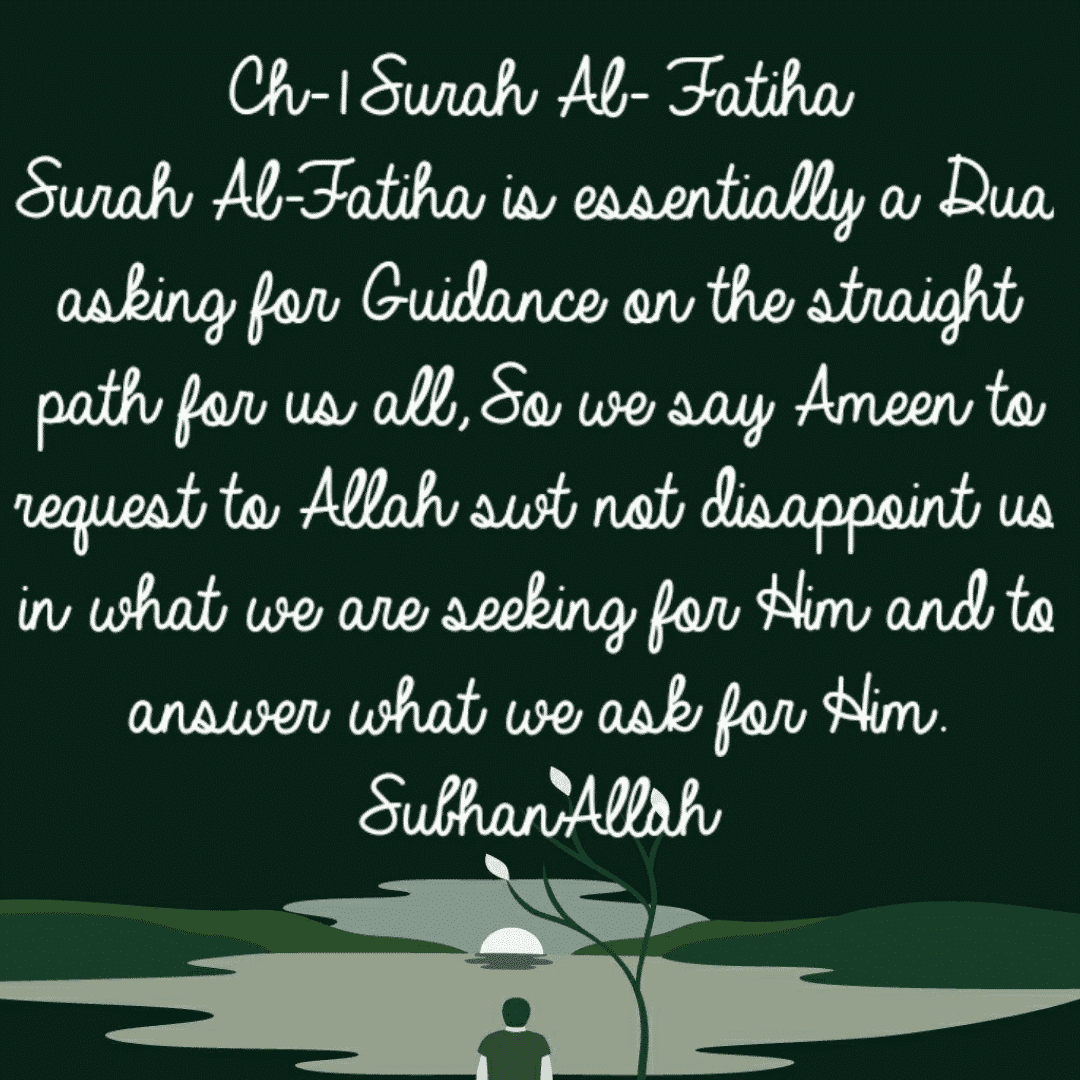
Allah has accepted the request (وَاِيَّاكَ نَسْتَعِيْنُۗ And we seek help only from You) given in Surah Fatihah and congratulated the people in other parts of Quran.
Allah taught the man himself how to supplicate in front of Allah and human beings are very lucky that the answer is also given by Allah in later parts of the Quran.
There is a discern of Allah’s kindness upon people in the below given Ayah in which Allah has promised to help the people if they are true believers
أَمْ حَسِبْتُمْ أَن تَدْخُلُوا الْجَنَّةَ وَلَمَّا يَأْتِكُم مَّثَلُ الَّذِينَ خَلَوْا مِن قَبْلِكُم ۖ مَّسَّتْهُمُ الْبَأْسَاءُ وَالضَّرَّاءُ وَزُلْزِلُوا حَتَّىٰ يَقُولَ الرَّسُولُ وَالَّذِينَ آمَنُوا مَعَهُ مَتَىٰ نَصْرُ اللَّهِ ۗ أَلَا إِنَّ نَصْرَ اللَّهِ قَرِيبٌ
Do you think that you will enter Paradise while such [trial] has not yet come to you as came to those who passed on before you? They were touched by poverty and hardship and were shaken until [even their] messenger and those who believed with him said, “When is the help of Allah?” Unquestionably, the help of Allah is near. Surat al-Baqarah:214
↓ 1 – We Learn about the Straight Path
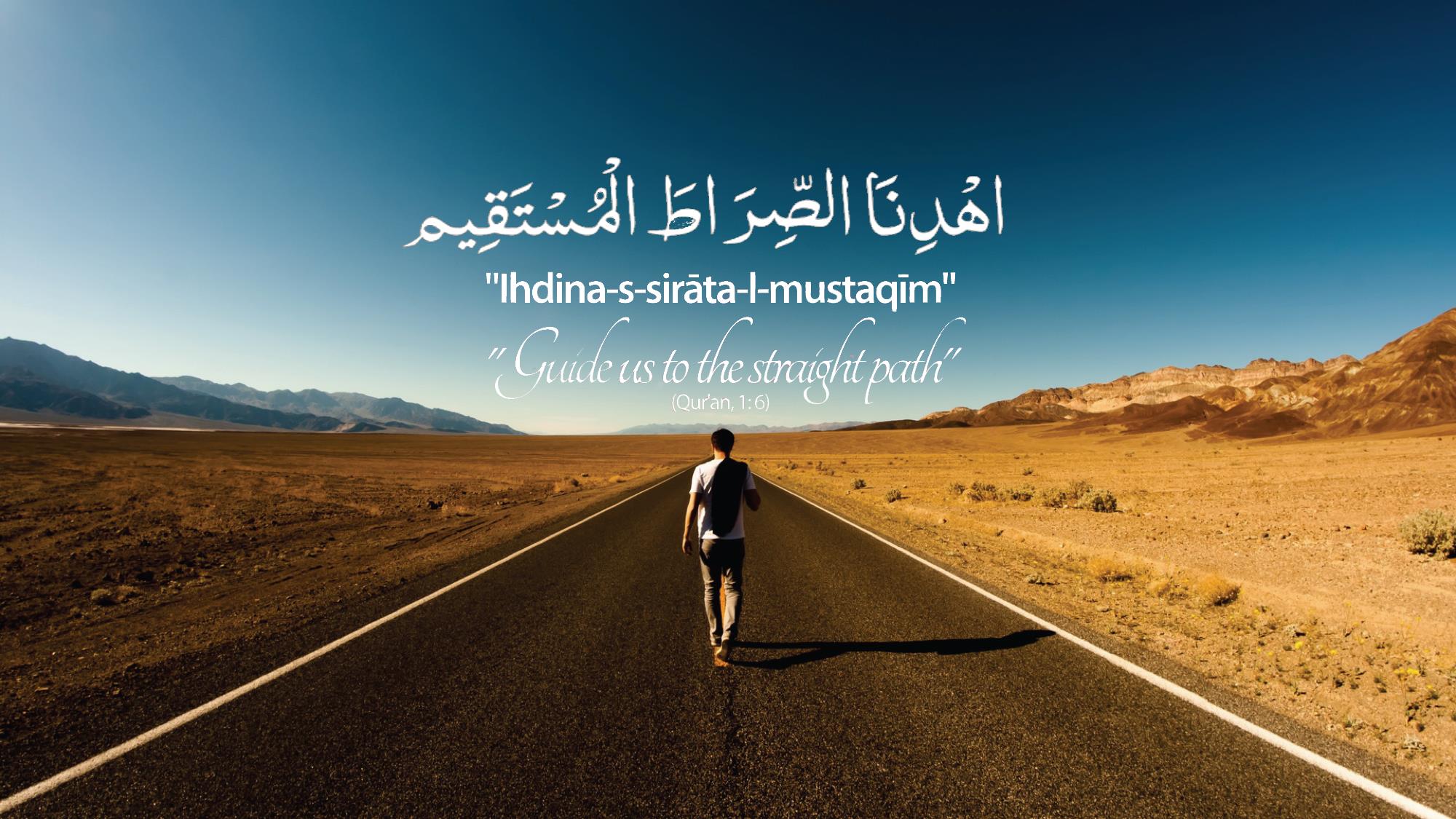
Allah SWT listens to and accepts the question (اِهْدِنَا الصِّرَاطَ الْمُسْتَقِيْمَ Guide us the straight path) which Allah SWT has taught mankind Himself
and give answer (وَأَنِ ٱعْبُدُونِى ۚ هَـٰذَا صِرَٰطٌۭ مُّسْتَقِيمٌ)
And that You worship only Me, This is the straight path. Surat Yasin:61
Allah SWT also mentions in Surah Fatihah the people on which Allah SWT has bestowed His blessings so that there would be an example for Muslims regarding whom they should try to be like. In this context, Allah SWT guide us to follow the path of four types of people
- Nabiyyeen (Prophets)
- Siddiqeen (Truthful people)
- Shuhada (Martyrs)
- Saliheen (Righteous)
And forbidden us from two types of people who have gone astray from the right path
- Those who earned Allah’s anger (knowingly rejected the truth)
- Those who went astray (lacked knowledge)
Many classical commentators gave the Jews and the Christians as examples of these two groups, but the warning applies to anyone of any community who falls into these errors.
Concluding Remarks:
The main concepts unfolded in Surah Fatihah and elaborated in the rest of the Quran are the same i.e., Faith, Nabuwwat, Day of Judgement and essentially worshipping and seeking help from Allah SWT
Frequently Asked Questions
Is Surah Al-Fatihah obligatory in every prayer?
Reciting it is central to the prayer. The Shafi’i, Maliki and Hanbali schools consider it a pillar of every rak’ah, while the Hanafi school considers it wajib. Whether a person praying behind an imam recites it aloud or silently also differs between schools, so follow the school you practise or ask a qualified scholar.
Why is Surah Al-Fatihah called Umm al-Quran?
The Prophet (peace be upon him) called it Umm al-Quran and as-Sab’ al-Mathani (the seven oft-repeated verses), because it gathers the Quran’s main themes: praise of Allah, His lordship and mercy, the Day of Judgement, worship, seeking help and guidance.
Is it Makkan or Madinan?
The majority of scholars hold that it was revealed in Makkah, and this is the view reflected in this article. A minority held that it was revealed in Madinah or twice.
Can Surah Al-Fatihah be used for ruqyah?
Yes, there is an authentic report of a Companion reciting it as ruqyah and the Prophet approving. It is a supplication seeking healing from Allah and does not replace medical care. For personal situations, consult a trusted scholar and a doctor.
What should I say after the Fatihah in prayer?
Saying “Ameen” is a sunnah after it. Scholars differ on whether the imam and followers say it aloud or silently in loud prayers. You can also read about the reasons to read Surah Al-Kahf.