
How To Perform Salah. Salah is the second pillar of Islam mentioned by the Prophet Muhammad (SAW) after the declaration of faith which makes a person Muslim. It has been made an obligation for every Muslim to fulfill. Allah (SWT) says “..and I have chosen you, so listen to that which is inspired to you. Verily, I am Allah! There is none worthy of worship but I, so worship Me and offer prayer perfectly for My remembrance.” [Taha 13-14]
Salah is a form of worship that connects the people with their Creator and it must be performed five times a day regularly without any excuse. Therefore, it is important to learn the correct way of performing it. The Quran mentions establishing the prayer repeatedly, often alongside zakat, which shows how central it is to faith.
What Is The Right Method Of Performing Salah

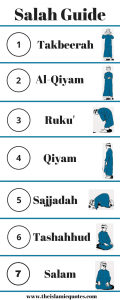
↓1 – Before Salah
There are a few preconditions of Salah that must be fulfilled. You need to be sure that your body, clothes and the place where you are praying is clean. You must perform ablution, face the right direction of Qibla, cover yourself properly and pray at the right time. See our guide on how to perform wudu (ablution), and for help staying focused read how to concentrate on Salah.
↓2 – Make Niyyah
It is very important to make the intention before initiating the salah. It does not need to be said out loud, you can make your intention in your heart.
↓ 3 – Takbeerah
Raise your hands and say “Allah-o-Akbar”, this means Allah is the Greatest of all. In the Hanafi school, men raise their hands to the ears and women to the shoulders; other schools raise the hands to the shoulders or ears for both. Any of these is based on reports from the Prophet (PBUH), so follow your school.
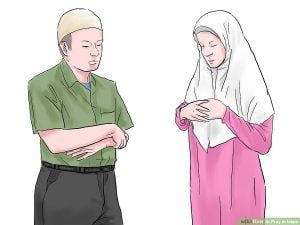
↓ 4 – Al-Qiyam
Now perform qiyam by placing your right hand over the left one, in the Hanafi school men place them below the navel and women on the chest; the Shafi’i and Hanbali schools place them on or just below the chest (Hanbalis also allow below the navel), and the Maliki school commonly allows either placing them on the chest or letting them rest at the sides.
1) Recite the opening dua: “Subhanaka allahumma wa bi hamdika wa tabara kasmuka wa ta’ala jadduka wa la ilaha ghairuka.”
Translation: “O Allah, how perfect You are and praise be to You. Blessed is Your name, and exalted is Your majesty. There is no god but You.” [Only recite this supplication, Subhanaka, at the beginning of the first Rak’ah]
2) Then recite: “A’udhu billahi minash shaitanir rajeem.”
Translation: “I seek protection in Allah from the rejected Shaitan.”
3) Then recite Tasmiyah: “Bismillahir rahmanir raheem.”
Translation: “In the name of Allah, the most Beneficial, the most Merciful.”
4) Then recite Surah Fatihah: “Al hamdu lil lahi rabbil ‘alamin. Arrahmanir rahim. Maliki yawmiddin. Iyyaka na’budu wa iyyaka nasta’in. Ihdinas siratal mustaqim. Siratal ladhina an’amta’alaihim, ghairil maghdubi’alaihim wa lad dhallin. (Ameen)”
Translation: “All praises and thanks be to Allah, the Lord of the worlds, the most Gracious, the most Merciful; Master of the Day of Judgment. You alone we worship, from You alone we seek help. Guide us along the straight path – the path of those whom You favored, not of those who earned Your anger or went astray.”
Surah Fatihah is recited in every rakat when praying alone or leading. When praying behind an Imam, scholars differ: the Hanafi school says the follower stays silent, while the Shafi’i school requires the follower to recite it quietly as well.
5) Now recite any Surah or verses from the Quran, for example Surah Ikhlas: “Qul hu wal lahu ahad, allahus samad, lam yalid wa lam yulad, wa lam ya kul lahu kufuwan ahad.”
Translation: “Say, He is Allah, the One. Allah, the Eternal Refuge. He neither begets nor is born, and there is none comparable to Him. ”
↓ 5 – Ruku’
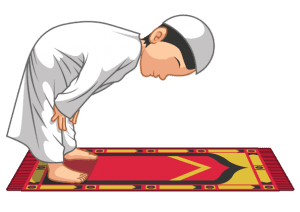
Now say ‘Allah-o-Akbar’ and bow down keeping your hands on your knees. Recite:
“Subhana Rabbiyal Adhim.” (x3)
Translation: “How Perfect is my Lord, the Supreme.”
RECOMMENDED: 40 Beautiful Dua for Recitation
↓ 6 – Qiyam
Now stand straight with your hands by your side and recite: “Sami’Allahu liman hamidah. Rabbana lakal hamd.”
Translation:“ Allah hears those who praise Him. Our Lord, praise be to You. ”
This position is known as Qawmah position.

↓ 7 – Sajjdah
Recite ‘Allah-o-Akbar’ and prostrate on the floor. Place your hands, knees and head on the floor. It is important that the knees touch the ground first, thereafter the hands and forehead must be placed. The fingers and toes should be towards the Qiblah. In the Hanafi school men keep the feet upright with the toes facing the Qiblah, while women sit more compactly with the feet brought out to the right; other schools make little or no distinction between men and women here. Once you are in the right position, recite:
“Subhana Rabbiyal A’la” (x3)
Translation: “Glorious is my Lord, the most High.”
Sit up from this position saying “Allahu Akbar” and then prostrate again reciting “Subhana Rabbiyal A’la” thrice.
This completes one rakat of your salah.

↓ 8 – Tashahhud
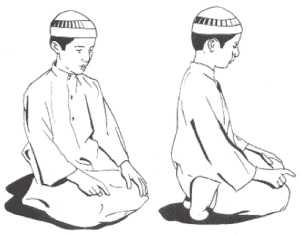
After the second sajjdah of your second rakat say ‘Allah-o-Akbar’ and rise from sajjdah to sit on your knees and place your hands on your knees. Now recite: “At-tahiyyaatu Lillaahi wa-salaawaatu wa-tayyibaat. As-salaamu ‘alayka ayyuha-Nabiyyu wa rahmatullaahi wa barakaatuhu. As-salaamu ‘alayna wa ‘ala ‘ibaad-illaah-is-saaliheen. Ash-hadu al-laa ilaaha ill-Allaaho wa ash-hadu anna Muhammadan ‘abduhu wa rasooluhu.”
Translation: “All compliments, prayers and pure words are due to Allaah. Peace be upon you, O Prophet, and the mercy of Allaah and His blessings. Peace be upon us and upon the righteous slaves of Allaah. I bear witness that there is no god except Allaah and I bear witness that Muhammad is His slave and Messenger. ”
While reciting this, when you reach ‘laa ilaha’ join the fingers and connect the middle finger and thumb to make a ring and rise your index finger towards the sky. However, the index finger should not be held up till the end and must be lowered as you reach ‘ill-Allaaho’
Now recite blessing upon on beloved Prophet Muhammad (SAW): “Allaahumma salli ‘ala Muhammad, wa ‘ala aali Muhammad, kama salayta ‘ala Ibraaheem, wa ‘ala aali Ibraaheem, innaka hameedun majeed. Allaahumma baarik ‘ala Muhammad, wa ‘ala aali Muhammad, kama baarakta ‘ala Ibraaheem, wa ‘ala aali Ibraaheem, innak hameedun majeed.”
Translation: “O Allaah, send prayers upon Muhammad and upon the family of Muhammad, as You sent prayers upon Ibraaheem and the family of Ibraaheem, You are indeed Worthy of Praise, Full of Glory. O Allaah, bless Muhammad and the family of Muhammad as You blessed Ibraaheem and the family of Ibraaheem, You are indeed Worthy of Praise, Full of Glory”.
After reciting durood-e-ibraheemi, you should recite some duas necessary to ask for forgiveness of your sins from Allah (SWT).
Via
↓ Salaam
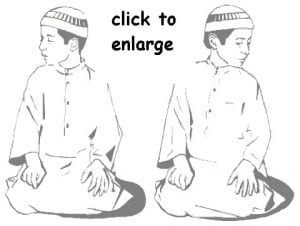
Once you have completed your tashahhud, durood and several duas end your Salah by turning your face to the right side and then to the left and saying “As-salamu alaykum wa rahmatullah” on both sides. Adding “wa barakatuhu” is also reported and accepted by some scholars. For 3- and 4-rakat prayers, after the first tashahhud (sitting after two rakats) you stand up for the remaining rakats, and the durood and final salaam come only in the last sitting. Procedures differ slightly between schools, so follow a qualified teacher for your school.
Via
↓ Step by Step Video Tutorial on How to Pray Namaz
Frequently Asked Questions
Do I have to say the niyyah (intention) out loud?
No. The intention is in the heart. Some later scholars permitted or recommended uttering it quietly to help focus, but there is no authentic report that the Prophet (PBUH) did so.
Why do the schools of thought pray slightly differently?
The schools rely on different authentic reports and methods of interpretation for details such as hand placement, reciting behind the Imam and sitting postures. These are differences within valid scholarly opinion. Follow the school you were taught, and ask a qualified scholar for a personal ruling.
What are the five daily prayers and their rakats?
Fajr has 2 fard rakats, Dhuhr 4, Asr 4, Maghrib 3 and Isha 4. Sunnah and witr prayers are additional, and counts for them vary slightly between schools.
How can I improve my focus in prayer?
Learn the meaning of what you recite, pray without rushing and prepare beforehand. See how to concentrate on Salah.
What do I need before starting the prayer?
You need to be in a state of purity, wear clothes that cover the required parts of the body, be in a clean place, face the Qiblah and pray at the proper time. Read how to perform wudu.