
Symptoms Of Nazar And Its Protection In Islam. We often hear people use this phrase ‘Nazar lag jayegi’, so what actually is Nazar? In simpler terms, ‘Nazar’ is referred to as the evil eye. It is the harm or misfortune that is transmitted from one person to another person out of jealousy or envy.
Nazar can be intentional or unintentional. Most likely to be affected by the evil eye are the young, wealthy and beautiful beings. It is not compulsory that the one who is inflicting the evil eye looks in the eyes of the victim, it can be done through visualizing or just imagining. Therefore, Prophet Muhammad (SAW) advised us to recite ‘MashaAllah’ every time we look at something with exhilaration in order to prevent casting the evil eye.
What Is The Concept Of Evil Eye In Islam and Duas to kill Nazar
↓ The Concept Of Evil Eye In Islam
We live in a world where many people deal with stress, anxiety and mental and physical strains. These kind of people are sometimes jealous of the ones who live a happy and stress-free life and as a result they cast the evil eye. The concept of ‘evil eye’ is confirmed in Islam as it has been quoted in many of the hadiths and in the Holy Quran.
Here are 50 Beautiful Rumi Quotes About Love, Life & Friendship.
Prophet Muhammad (SAW) said: “The evil eye is real, and if anything were to overtake the divine decree (al-qadar) it would be the evil eye.” [Muslim]
In another narration, which some scholars grade hasan, he said: “The evil eye puts a man in the grave and a camel in the cooking pot,” meaning it can have a serious effect.
The Holy Quran also confirm the evil eye through various verses. One of them is:

↓Types Of Evil Eye
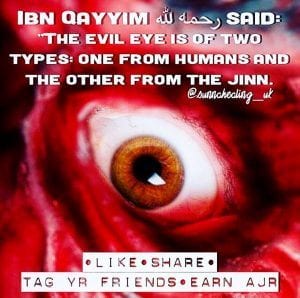
There are two different types of evil eye that can be afflicted to other. Ibn al-Qayyim (rahimahullah) said: “The evil eye is real.The evil eye is from two sources: the evil eyes from mankind and the evil eye from Jinn. Both types of the evil eye have been confirmed through many narrations. The mankind evil eye is confirmed as Abu Sa’id al-Khudri (radiallahu anhu), who said that the Prophet (صلى الله عليه و سلم) said to seek refuge from jinn’s and the evil eye from mankind. (At-tirmidhi, 2058)
Whereas the evil eye from jinn’s, it has been narrated by Umm Salamah (radiallahu anhaa) that the Prophet (صلى الله عليه و سلم) saw in her house a slave girl and in her face was sa faa’ah. upon which the Prophet (صلى الله عليه و سلم) said: ” Seek Ruqyah for her, for verily she is afflicted with a look (evil eye). ” (Al-Bukhari, 5739)
The scholars have said “As-sa-faa’ah” is the evil eye from Jinn’s.
↓ Symptoms Of The Evil Eye
So how does one get to know that he or she has been inflicted with the evil eye? Well, there are symptoms of that.
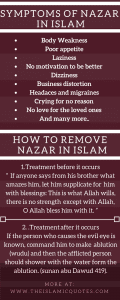
Sheikh Abd ul-Azeez al-Sadhaan (may Allah preserve him) said:“If it is not from a real illness, then the symptoms [of evil eye] may take the following forms:
- Headaches that move from one part of the head to another
- Face turning yellow
- Sweating and urinating a lot
- Poor appetite
- Palpitations in the heart
- Pain in back and shoulders
- Anxiety and stress
- Sleepless nights
- A great deal of reactions due to abnormal fears
- A lot of yawning and burping
- Withdrawal of love and solitude
- Laziness
- Health issues without any major medical cause
Note: these signs are common to many ordinary medical and psychological conditions and are not proof of the evil eye. See a doctor first, and do not diagnose yourself or others. These signs or some of them may be present according to the strength of the evil eye or the number of people who put the evil eye on others.”
Some people also report other signs, which are not established in the Quran or Sunnah and may have medical causes. They include crying without any reason, liking isolation, constant dizziness, being angry all the time, fearing death and shivering, depression, tightness of chest, problems in business and sometimes women loosing their hair. These can have many causes, so please seek medical advice and consult a qualified scholar if you are concerned.
↓ Protection From The Evil Eye
The first and foremost things the Muslims should do is have faith in Allah (SWT), they should have a firm belief that only Allah (SWT) has the power to protect or harm anyone. They should never turn to anyone other than Allah (SWT) to seek protection.
“Nothing happens to you except in accordance with God’s will. Anyone who believes in God, He will guide his heart. God is fully aware of all things.” [Quran 64:11]
There are two types of protection, one is before the affliction of the evil eye and one is after one has been afflicted.
According to scholars on ruqyahtreatment.com following are the treatments/protection before one has been caught by the evil eye:
i) When a person has a beautiful family he should guard them by seeking protection from Allah for them, teaching and commanding them to do so, and also by dressing them properly not to expose their bodies or beauty so as not to be envied and affected by the evil eye. The Prophet (saws) used to seek protection for Hassan and Hussein by saying
”I seek refuge for both of you in the perfect words of Allah and from every satan, vermin, and from every evil eye.”
ii) If someone has wealth, he should guard it by asking Allah to bless and protect it and be thankful to Allah.
iii) If someone has good news and he knows people will envy him because of it, he should guard it by keeping it secret.
It is very important to stay away from the people who are known for being envious and is known to affect people with the evil eye.
Now comes the treatment of the second category that is when one has been afflicted by the evil eye:
“If the one who cast the evil eye is identified, it is also recommended to have that person make wudu, and then pour the water over the person who was afflicted in order to rid them of the evil.” ((Sunan Abu Dawud 3880; see also Sahih Muslim 2188). Scholars note this applies when the person responsible is known and is asked to do so; it is not something to do to accuse others.).
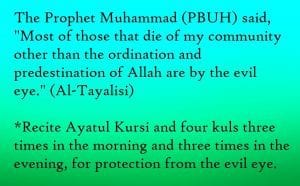
The Holy Quran confirms that the evil eye is real and thus provides us with Duas that help us seek protection from it. Regular recitation of Surah Falaq, Surah Nas and Ayat al-Kursi is part of the Sunnah (see also the benefits of Surah Baqarah). As Surah Falaq says “In the name of God, Most Gracious, Most Merciful. I seek refuge in the Lord of daybreak. From the evils among His creations. From the evils of darkness as it falls. From the evils of the troublemakers. From the evils of the envious when they envy.”[Quran 113:1-5].
RECOMMENDED: 25 Most Powerful Islamic Duas Every Muslim Should Know.


↓ Example Of Protection From Allah (SWT) Against The Evil Eye
The following story is quoted in some books, but we have not found an authentic chain for it, and the words it attributes to the narrator should not be treated as a sunnah dua. It is kept here only as a cautionary tale. Abu Abdullah al Tayahi is said to have been once on his way to a pilgrimage to Makkah riding on a beautiful and swift camel. A man known for inflicting malevolent evil eye was also in the same caravan of travellers. His evil was so great that he would rarely look at something and it would not collapse.
Half way though the journey, someone mentioned to Abu Abdullah, “Guard your camel against the malevolent eye of this man!”
Abu Abdullah replied, “He can force no harm upon my camel.”
An eavesdropper heard the conversation and went back to tell the owner of the evil eye. In pride and arrogance, the malevolent person waited for Abu Abdullah to be busy and away from his camel, so he stood before it and gazed at it. Immediately the camel became enraged and fell to the ground.
When Abu Abdullah returned, he was told what had happened. He demanded, “Lead me to him!” As soon as he saw the man, Abu Abdullah recited the following prayer;
“I call upon the Sovereign Name of Allah, the power of which curbs aggression, Whose shelter is sacred, and Whose barrier is unbreakable, and which is a burning brand against mischief; and by its supremacy, I rescind and nullify the effects of the malevolent evil eye, and cast such effects back upon the aggressor and what he loves most. [He then quoted the Holy Qur’an]; Look carefully, do you see a single flaw therein? Yet look once more, and again, your sight will return to you in a state of humiliation and worn out.” (67:3-4)
Immediately the eyeball of the evildoer popped out if its socket, thus he lost his sight. The camel got back on her feet, vindicated and cured.
↓ Dua for Protection from Nazar

Via
Frequently Asked Questions
Is the evil eye (nazar) real in Islam?
Yes. The Prophet (peace be upon him) said that the evil eye is real (Sahih Muslim 2188). At the same time, scholars stress that nothing harms or benefits except by the will of Allah.
How can I protect myself and my family from the evil eye?
Recite the morning and evening adhkar, Ayat al-Kursi, Surah Ikhlas, Surah Falaq and Surah Nas, and seek refuge in Allah with the duas taught by the Prophet. Say MashaAllah when you admire something. See also our dua collection.
Are amulets, beads or hanging objects allowed for protection?
Scholars generally warn against wearing amulets or charms believed to protect on their own, as this can lead to shirk. Protection should be sought from Allah alone through the Quran and authentic duas.
What if I think I have been affected by the evil eye?
Rule out medical causes by seeing a doctor, and turn to ruqyah using the Quran and authentic duas, ideally recited by yourself or a trusted, knowledgeable person. For your personal situation, please ask a qualified scholar.
Is it a sin to cast the evil eye on someone?
Envy is condemned in Islam, and a believer should say MashaAllah or barakallahu feek when seeing something that impresses them, so that no harm is intended or caused. Scholars differ on details of how to deal with a known offender, so consult a scholar.
Here Are Some Benefits Of Astaghfirullah