
Fitting In As a Hijabi in the USA: Race. Color. Religion. Appearance. The world is full of diverse people, and each of them is judged by their appearance. But Why? As a young Muslim girl living in present-day America, my life was full of diversity.
I first started wearing Hijab in 7th Grade at Schuyler-Colfax Middle School. A public school. Yes, it was hard, it was tough. But that’s why I will always keep my head held high.
The term “Hijab“ means a separator, a curtain, or a screen. It is not the term used in Islam for women’s headcover. The women’s headcover term used in the Holy Quran is “Khimar”, which means in Arabic, a head covering or veil. But in recent decades, Muslims in the west and the media use the term “hijab” to define the headcover of Muslim women.
Hijab is worn by Muslim women in public all around the world not only in Arabic countries. Women cover their hair in all religions.
People may stare, people may whisper, but that’s what makes me stronger.
Each person is different. You may have heard that before. Each person is suffering from something greater than the other.
I had a best friend in 6th Grade and I told her that I was going to start wearing the Hijab the following year. The next year came, and she decided to start to ignore me. I took this as a test from Allah (SWT) and decided it was to move on. I became making different friends that accepted who I was, not what I looked like.
This goes to show that as a Muslim woman wearing the Hijab in America, I always get perceived the wrong way.
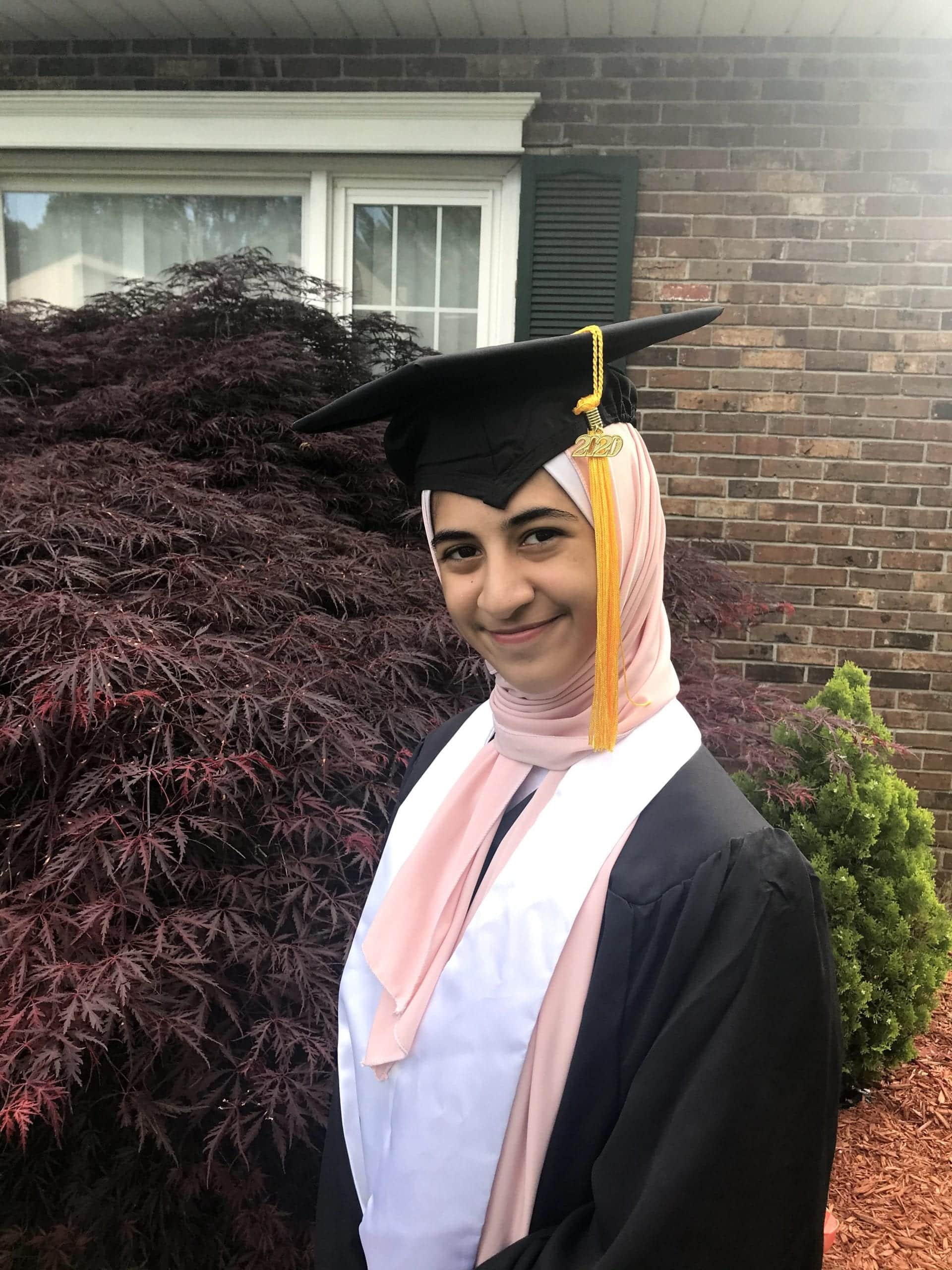
Miriam graduates from Schuyler Colfax Middle School – 2020.
Fitting into society is hard for some, but why go through all that suffering when nobody is forcing you to. Why try and be like others, when you have yourself. This is what I ask myself when I see the others stare or when I see them whisper. Because if they really knew the truth, we would all fit in.
Why Is Hijab Important To Me?
- It represents honor, dignity, and modesty.
- It focuses on personality rather than looks.
- It represents you and your beliefs.
- It represents freedom of choice.
Did you know that hijab-wearing Muslim women now serve in public office and parliaments around the world, from the United States to the United Kingdom?
Maryam (Mary), the mother of Jesus (peace be upon them both), is honoured in the Quran, and she is commonly depicted in art and tradition with her head covered.
Hijab Should Not Be Seen As A Hindrance To One’s Academic Or Career Opportunities
Here are some well known Mulsim women with Hijab:
- Ibtihaj Muhammad is an American saber fencer, she is best known for being the first Muslim woman to wear the headscarf (Hijab) while competing for America in the Olympics. Not only that, but she also earned the bronze medal as part of Team USA in the Team Sabre.
- Dalia Mogahed is an American scholar. Mogahed is the Director of Research at the Institute for Social Policy and Understanding (ISPU) in Washington, D.C. Mogahed was also selected by the President, Barack Obama, to the Advisory Council on Faith-Based and Neighborhood Partnerships.
- Kadra Mohamed is a Somali-American police officer in Minnesota who is widely reported as one of the first officers there to wear the Hijab on duty.
- Doctor Dalia Fahmy is a Professor in Political Science at a University in Long Island. There she teaches courses on U.S. Foreign Policy, World Politics, International Relations, and many more.
- Ilhan Omar is a Somali-American politician from Minnesota. She was elected to the Minnesota House of Representatives as a Democratic-Farmer-Labor Party member in 2016, becoming the first Somali-American legislator in the United States, and later went on to serve in the U.S. House of Representatives.
- Ingrid Mattson is a religious leader, and a professor in Islamic Studies. Mattson is also an interfaith activist. As well as a former president of the Islamic Society of North America.
This just shows that Hijab cannot stop you or even prevent you in the least from your career opportunities.
World Hijab Day
World Hijab Day is an annual event that takes place on February 1st each year in 140 countries worldwide! Its purpose to encourage women of all religions and backgrounds to wear and experience the Hijab.
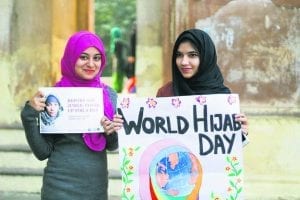
An annual event takes place on February 1st each year in 140 countries worldwide.
World Hijab day allows people to leave their comfort zone. It also allows them to feel and see what it is like to experience and see what wearing the Hijab is like. Some people claim it may be uncomfortable or even ugly. But you never know what it really feels like until you try.
World Hijab Day is for everybody and anybody that wants to participate or experience what Hijab feels like being in America. It gives you the true vision and experience because you are the one going about your day wearing the Hijab. You can feel and see how the people perceive you or look at you.
FAQ’s About Hijab
Q. Does anyone force, Muslim women, to wear Hijab? Do all Muslim women wear Hijab?
A. In the Quran (Surah Al-Baqarah 2:256), Allah says: “There is no compulsion in religion”. Scholars agree that covering is an obligation on Muslim women, just like the five daily prayers and fasting in Ramadan, but faith itself cannot be forced on anyone and each person answers to Allah for their own choices. That is why not every Muslim woman wears the hijab, just as not every Muslim prays five times a day or fasts in Ramadan. The details of what must be covered differ slightly between the schools of thought, so ask a qualified scholar for a personal ruling.
Q. When do Muslim women start wearing Hijab?
A. From an Islamic perspective, one is required to start wearing a hijab when they reach puberty. But if a woman wants to start wearing it at any stage of her life, she’s welcome to do it.
Q. Is it hot in the summer to wear Hijab?
A. When it’s hot, it’s hot for everyone, the Hijab can provide shelter from the sun. You can also choose thinner and breathable fabrics to wear hijab in hotter seasons.
Everybody has their own ways of expressing themselves. Each person is different in their own ways. Wearing the Hijab is a gift from Allah (SWT) (you can read more in these Islamic quotes about hijab). He blessed us with so much in our lives. Wearing the Hijab can protect you, but also prove to the people that you are different and you stand out. That you are special in your own way.
Different races, colors, religions, it doesn’t matter. Because you never know if the person you judge by their appearances, could actually become your best friend.
Frequently Asked Questions
Is hijab compulsory for Muslim women?
Most scholars across the major schools hold that covering the hair and body in front of non-mahram men is an obligation, based on verses such as Surah An-Nur 24:31 and Surah Al-Ahzab 33:59. Scholars may differ on details such as what exactly must be covered. For a personal ruling, ask a qualified scholar.
Is the word “hijab” used in the Quran for the headscarf?
In the Quran, “hijab” generally means a screen or partition, while the head covering is referred to as “khimar” (Surah An-Nur 24:31). Today, “hijab” is the common everyday word for the headscarf.
At what age should a girl start wearing hijab?
Scholars generally say it becomes obligatory at puberty. Many families encourage girls to start earlier so it becomes a comfortable habit, but it should be done with kindness and understanding, never harshness.
How can a hijabi cope with stares or unkind comments at school or work?
Many hijabis find strength in patience, supportive friends and community, and remembering their intention to please Allah. If the behaviour is discrimination or bullying, report it to a teacher, manager or the relevant authority. See also our collection of Islamic quotes on sabr (patience).
Can non-Muslims take part in World Hijab Day?
Yes. World Hijab Day, observed on 1 February, was started to invite women of all backgrounds to try wearing a headscarf for a day and learn about the experience of Muslim women.