
Periods in Islam: Menstruation is a natural process for a woman that occurs every month. However, the cycle can differ from person to person. A period often lasts about five to seven days, but this varies from woman to woman. In fiqh, the minimum and maximum length of haid differs by school (for example, the Hanafi school sets three to ten days, while the Shafi’i school sets a minimum of one day and a maximum of fifteen).
There are a lot of taboos and social stigmas related to menstruation. However, it is something not to be ashamed of. It is part of the natural design Allah has given women, and a woman shouldn’t be made embarrassed if she bleeds every month.
What Does Islam Say About Menstruation?
6 – Are periods dirty?
Periods aren’t dirty. Allah has ordained this time of the month to women and it should be accepted as it’s the will of our Lord. A woman does not pray or fast while she is in haid, and resumes after she is pure. SubhanAllah, this is a mercy from Allah. The ruling is an act of worship that Allah has set for this state, and many women also find it a time of physical rest. Aisha (RA) said that during her periods they were commanded to make up missed fasts but not missed prayers (Sahih Muslim).
During the times of illiteracy, before the prophecy of the Prophet (p.b.u.h), people would not sit with their wives, they used to avoid eating with them considering that the women were impure and dirty during menstruation.
However, after the prophet (p.b.u.h) came, he enlightened the people that it is okay to go near your wives, you can cuddle them and enjoy time together, only intercourse is prohibited. The Prophet (p.b.u.h) said, “Do everything except intercourse” (Sahih Muslim). Scholars differ on whether the area between the navel and the knees should be avoided: the Hanafi, Maliki and Shafi’i schools advise avoiding it, while others allow everything except intercourse.
5 – History of Periods
During ancient times, menstruation or menstrual blood had many labels. It was considered either cure or curse.
Many myths and superstitions grew around it, which Islam rejected.
Islam treats menstruation as a natural state and gives clear rulings for it.
In Arabic, it is termed as Haid. It is a religious state of Menstruation in Islam. Muslim women do not perform prayers or fast until they get purified, and scholars differ regarding touching or reciting the Quran (see below).
Once they get purified, they are subjected to continue their prayers and fastings.
4 – Things that are haraam in Islam during Menses
Enlighten your knowledge about what Allah has prohibited on you during this time of the month. For example, a menstruating woman cannot do the following until she gets purified.
• Penetrative intercourse
It is forbidden for a man to have penetrative intercourse with his wife when she’s on her period. Until she gets purified, it is haraam to perform sex with her. However, you can make love with her, you can cuddle her, sit with her, and nothing as such is forbidden.
• Divorce
Divorcing a wife during her period is forbidden according to the hadith of Ibn Umar (Bukhari and Muslim); the Sunnah way is to wait until she is pure. Most scholars hold that the divorce still takes effect though the man is sinful, while some scholars disagree.
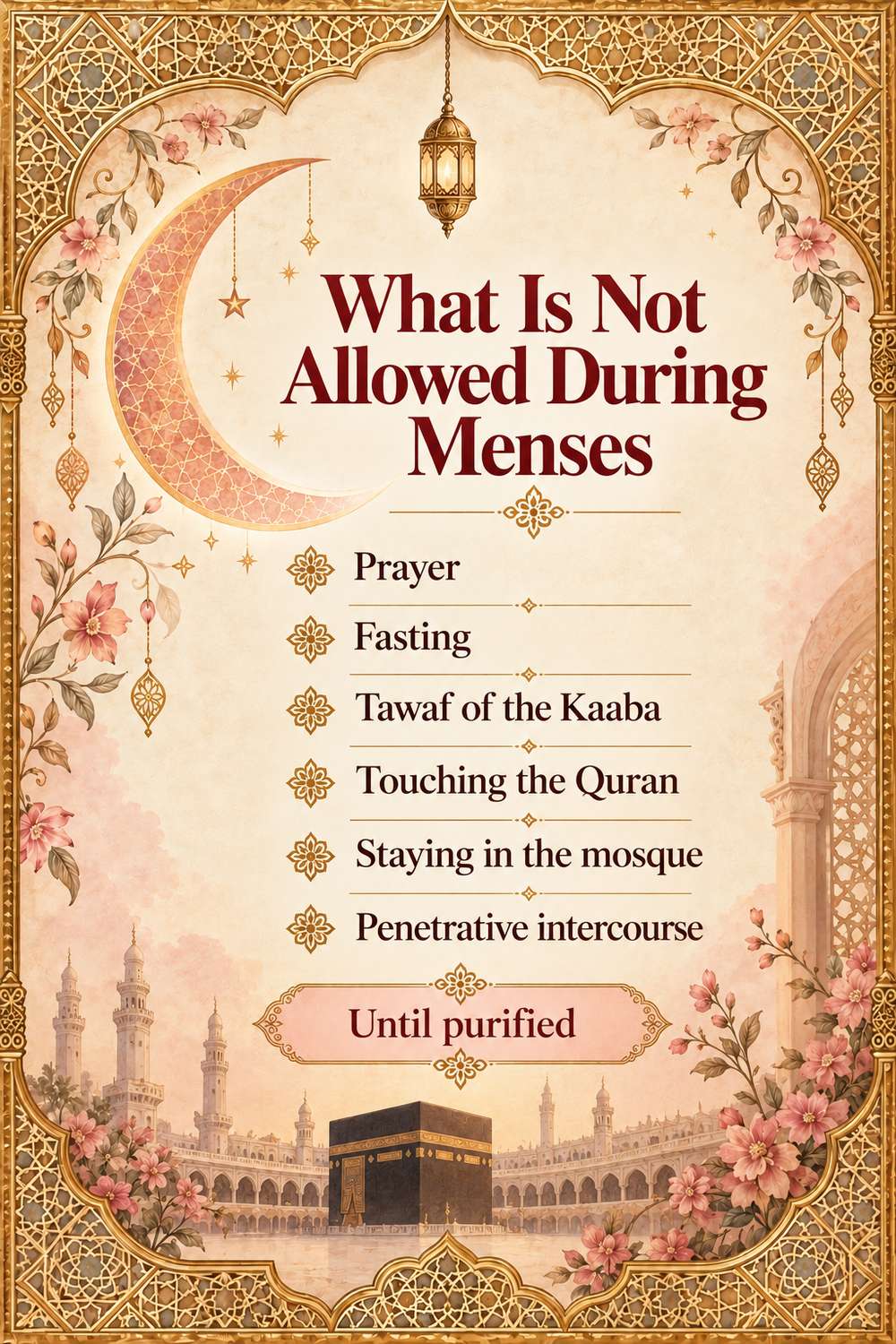
No prayers: Prayers are forbidden at this time of the month. You cannot pray till you get purified. You can resume your prayers once you get purified.
No fasting: Fasting is prohibited to women during Ramadan if their periods occur. However, once you get done with this time of the month, you resume fasting and make up the missed Ramadan fasts later (qadha). Missed prayers are not made up. For more details, you should go through our detailed post on Periods in Ramadan.
Tawaf of Kaaba: All the rituals can be performed except for tawaf of the Holy Kaba. You are prohibited to tawaf until you have cleaned yourself.
Holding the Quran: The majority of scholars (Hanafi, Shafi’i, Hanbali) say a woman in haid should not touch the mushaf directly, though she may touch it through a barrier such as cloth or use a phone or app. Regarding recitation, the Hanafi and Shafi’i schools restrict it, while the Maliki school and some other scholars allow it because of the length of the period. She can always listen to its recitation and translation. Follow your school or ask a scholar.
Staying in the mosque: The majority of scholars say a woman in haid should not stay in the mosque, as the Prophet (p.b.u.h) said he does not make the mosque lawful for a menstruating woman or a person in janabah (Abu Dawud, whose chain some scholars consider weak). Some scholars permit it when she is clean of any risk of soiling it, and the schools differ, so ask a qualified scholar.
Waxing: It is permissible to remove unwanted hair or trim nails during menses; there is no authentic text prohibiting it.
3 – Things that you can do during Menses
There is nothing to feel sad about Menses that you cannot gain any rewards as it’s a natural process given by Allah.
However, there are things that you can still do while you are in your menstruating period.
They are:
Listening to the recitation of the Holy Quran: It’s not an issue if she can’t hold the Quran or recite it, what she can do is she can listen to its recitation or the translation and enhance her knowledge and take comfort from it.
Do dhikr of Allah: She can do as much dhikr of Allah as she wants. There’s no prohibition while she does that.
Ask for Allah’s Repentance: She can make dua for her and ask for Allah’s repentance during this time of the month. So even if she’s impure and cannot pray, she still can make dua for herself. Here are the most Powerful Duas to Ask Allah for Forgiveness of Sins.
Give sadaqah (charity): Sadaqah should be done every day and month to protect ourselves from uninformed calamities and damages. Sadaqah is a lovable act in front of Allah so she can do it at this time of the month. Here are Islamic Quotes on Charity.
Hair dye: It is permissible in Islam for a woman to dye her hair while in periods. She is not supposed to wait till she gets purified to dye her hair.
2 – Periods on wedding night in Islam
It is strictly prohibited in Islam for a man to have penetrative intercourse on the wedding night if the bride is in the state of menstruation.
One should have to wait till his bride completely gets purified and then he can have intercourse with her.
1 – Signs of purification
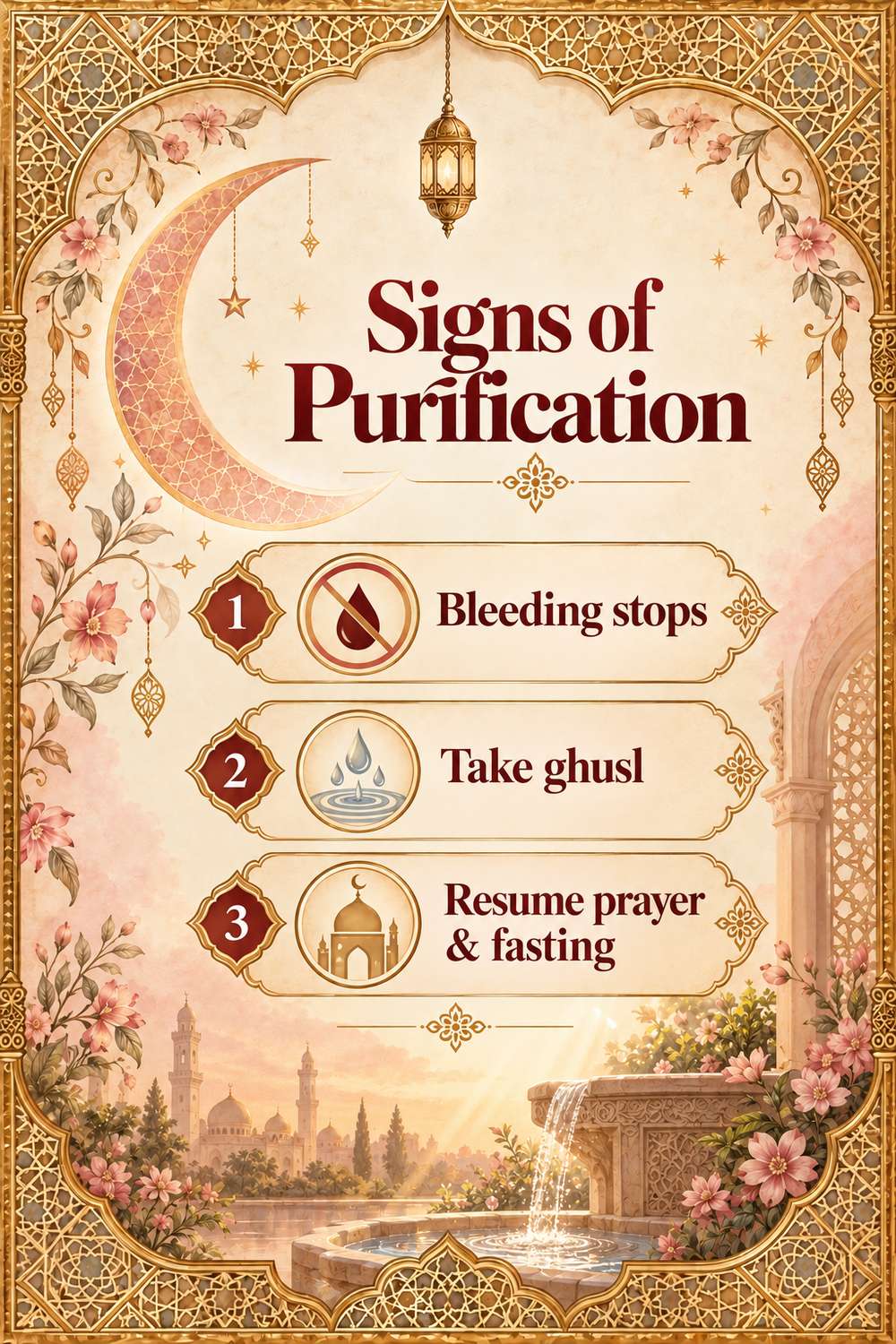
How would a woman know that she is done with her periods? There are some signs of purification with which you can know that the menses are now over. For example, there is a watery discharge from a woman’s womb after the blood has stopped. With the occurrence of such discharge, it is time to take ghusl and resume your prayers/fasting.
There are some cases when this white discharge doesn’t come out. In this case, a woman is instructed to check the dryness. Then, you can insert a cotton piece and check if there’s any blood spot. If yes, you can wait till it completely gets over.
And if there’s no clot, you can continue with your prayers and fastings.
Once she is pure she takes the obligatory ghusl (see our guide to ghusl in Islam), after which she resumes her prayers and fasting.
Conclusion
Menses are something not to be ashamed of. A woman should not feel that she cannot gain any reward at this time. There are a lot of good deeds she can still perform while in the menstruating state. Prohibit social stigma related to periods. Also, there is a need to converse on periods so that women in our society shouldn’t be made embarrassed if they bleed monthly. It’s a natural process and a sign of motherhood.
A woman does not pray or fast during her period, but nothing in the Quran or Sunnah prevents sitting with her, eating with her or being affectionate with your wife, other than intercourse. For personal rulings, ask a qualified scholar.
Frequently Asked Questions
Can a woman pray or fast during her period?
No. She does not pray or fast while in haid. After she is pure she makes up missed fasts, but she does not make up missed prayers (Sahih Muslim). See our guide on ghusl in Islam for the purification bath.
Can she recite or touch the Quran during her period?
Scholars differ. Many hold that she should not touch the mushaf directly, while the Maliki school and some other scholars allow recitation. She can listen to the Quran and make dhikr and dua at any time.
What can a husband do with his wife during her period?
Intercourse is forbidden, but the Prophet ﷺ said to do everything except intercourse (Sahih Muslim). Scholars differ on the area between the navel and the knees, so follow your school or ask a scholar.
How long does haid last in Islam?
The schools give different limits (for example, three to ten days in the Hanafi school and one day to fifteen days in the Shafi’i school). Women with irregular bleeding should ask a qualified scholar about their situation.
Can a woman perform Hajj or Umrah while on her period?
She may carry out the rites of Hajj except tawaf, which waits until she is pure (Sahih Bukhari, hadith of Aisha). For timing issues, consult a scholar or the Hajj group leader.